✨ Byte-Sized Overview
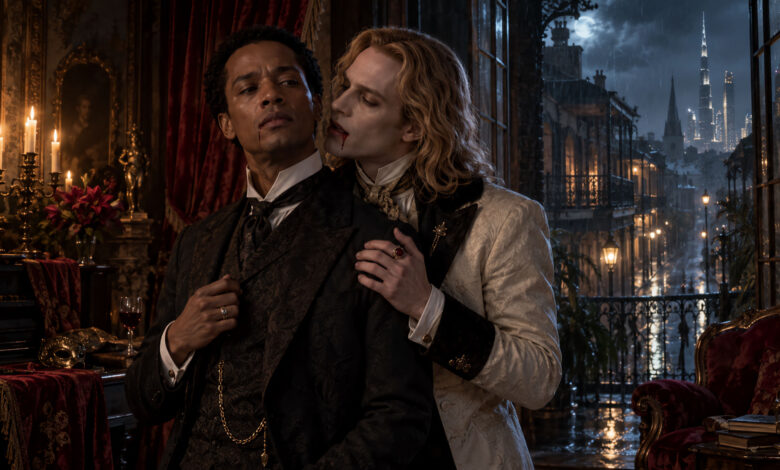
Eternal life sounds considerably less glamorous once you realise it may involve spending a century arguing with the same ex. Interview with the Vampire takes Anne Rice’s celebrated gothic novel and transforms it into a lavish, emotionally intricate television drama about love, memory, power and the stories people tell to make their worst behaviour appear slightly more reasonable.
In present-day Dubai, wealthy vampire Louis de Pointe du Lac invites veteran journalist Daniel Molloy to record the complete story of his life. They attempted something similar in San Francisco during the 1970s, but that encounter ended badly and left Daniel with incomplete memories. Louis now promises honesty, beginning with his life as a Black businessman in segregated New Orleans and his tempestuous relationship with the charismatic French vampire Lestat de Lioncourt. Daniel, older, sharper and unimpressed by supernatural theatrics, quickly discovers that honesty is a surprisingly flexible concept.
Jacob Anderson gives Louis intelligence, sorrow and suppressed fury, while Sam Reid attacks the role of Lestat with all the restraint of a peacock entering a jewellery shop. Their chemistry drives the series, but the relationship is never reduced to gothic wish fulfilment. It is passionate, manipulative, violent and painfully difficult to escape. Claudia, the young vampire they create together, turns their grand romance into a dysfunctional family drama with consequences that reach across decades.
After two seasons centred upon Louis’s testimony, the programme changes shape. Its third season, retitled The Vampire Lestat, allows Lestat to challenge the published account and seize control of the narrative through interviews, memories and an extravagant rock tour. The result is not a tidy correction of earlier events but another subjective version of them. Every narrator brings wounds, vanity and an agenda, making the truth something the audience must assemble from competing recollections.
🎬 Transmission Details
- Show Title: Anne Rice’s Interview with the Vampire / Anne Rice’s The Vampire Lestat
- Years: 2022–present
- Created By: Rolin Jones
- Network: AMC and AMC+
- Seasons: 3
- Episodes: 22
- Starring: Jacob Anderson, Sam Reid, Eric Bogosian, Assad Zaman and Delainey Hayles
- Supporting Cast: Bailey Bass, Ben Daniels, Jennifer Ehle, Joseph Potter, Justin Kirk, Christopher Heyerdahl and Sheila Atim
- Genre: Gothic horror, supernatural drama, dark fantasy and gothic romance
- Status: Returning Series
🎯 Signal Strength
- IMDb: 8.1/10
- Rotten Tomatoes: 99% average critics’ score for Interview with the Vampire; The Vampire Lestat scored 98%
- Skully’s take: A sumptuous queer gothic epic in which everyone is beautiful, immortal and catastrophically incapable of having a sensible conversation.
Ratings checked 6 September 2026 and may change.
📼 Spoiler Mode: Story Sync for Pub Chat
Major spoilers follow for all three released seasons, including the complete 2026 season of The Vampire Lestat.
In 2022, Louis de Pointe du Lac welcomes journalist Daniel Molloy to his Dubai penthouse and begins recounting his life in New Orleans. In 1910, Louis manages several businesses in Storyville while supporting his family and navigating the racism of the period. He attracts the attention of Lestat de Lioncourt, a powerful French vampire who seduces him and reveals his supernatural nature. After Louis’s brother Paul dies and Louis suffers a breakdown during Paul’s funeral procession, Lestat offers him escape through immortality. Louis accepts and becomes a vampire.
Louis and Lestat live together as lovers, but their approaches to killing differ sharply. Lestat feeds freely upon humans, whereas Louis struggles with guilt and attempts to survive without indiscriminate murder. Their relationship becomes increasingly controlling, particularly after Lestat begins an affair with singer Antoinette Brown. During the destruction of Storyville, Louis rescues a badly burned teenage girl named Claudia. To save her life, Lestat turns her into a vampire.
Claudia initially embraces her powers, but remaining physically adolescent becomes a source of anguish. She grows intellectually while being denied an adult identity, companionship and independence. After a doomed romance ends in tragedy, Claudia resents both of her creators. Lestat’s violence against Louis confirms her belief that they must escape him. She devises an elaborate murder, poisons Lestat and cuts his throat during Mardi Gras. Louis cannot bring himself to burn the body, however, and he and Claudia leave New Orleans knowing Lestat may survive.
Their search for other vampires takes them through war-torn Europe and eventually to Paris. Claudia and Louis encounter the Théâtre des Vampires, a theatrical coven led publicly by Santiago but controlled by the ancient vampire Armand. Armand begins a relationship with Louis, while Claudia falls in love with human dressmaker Madeleine. Claudia eventually turns Madeleine with Louis’s assistance, creating the companion she has always wanted.
The coven arrests Louis, Claudia and Madeleine and stages a public trial exposing their attempted murder of Lestat. Lestat appears as a witness, seemingly condemning them, although later recollections reveal that he covertly saves Louis by influencing the human audience. Claudia and Madeleine are exposed to sunlight and killed. Louis survives after Armand frees him, then burns the theatre and kills most of its vampires. He spares Santiago long enough to behead him personally.
Louis believes Armand rescued him, and the two remain together for decades. Daniel gradually uncovers the deception hidden within Louis’s recollections. Armand directed the trial, chose Claudia’s sentence and planned to let Louis die. It was Lestat, not Armand, who saved him. When Daniel exposes this truth in Dubai, Louis ends his relationship with Armand.
Louis returns to New Orleans and finds Lestat living in isolation. Their reunion centres upon their shared grief for Claudia. Lestat admits that he saved Louis at the trial but could not save Claudia, and Louis comforts him as a hurricane approaches. Daniel publishes the interview as a book, publicly exposing vampire history. Armand retaliates by turning Daniel into a vampire, despite having previously treated vampirism as a gift he would never offer. Louis, meanwhile, announces his identity to the vampires threatening him through the global mind connection and invites them to come for him.
Two years later, Lestat responds to Daniel’s book by forming a rock band and beginning a tour under the name The Vampire Lestat. He presents his own history through a documentary-style interview, disputed memories and original songs. His account returns to his brutal upbringing in Auvergne, his relationship with his mother Gabriella and his first love, the violinist Nicolas de Lenfent. In Paris, Lestat was abducted and transformed by Magnus, who killed himself shortly afterwards and left his fledgling traumatised and alone.
Lestat’s tour coincides with the Great Conversion, a rapid increase in the vampire population encouraged by his music and growing influence. Louis and Lestat move cautiously towards reconciliation, bonded by their continuing grief over Claudia. A séance conducted by the witch Merrick apparently allows Claudia to confront both men, telling them how profoundly they failed her.
Daniel and Armand, now working together, attempt to stop Lestat from inspiring an enormous new wave of vampire creation. They release footage revealing that Lestat’s sexual partner Sofia is actually his mother, Gabriella. Louis already understands the disturbing nature of that relationship and ultimately refuses to abandon Lestat. With scandal unable to separate them, Daniel and Armand resort to physical intervention. Assisted by Alex, they decapitate both Louis and Lestat on the night before Lestat’s Montreal concert.
While Louis remains conscious, Armand subjects him to a bitter confession and reveals further manipulation, including his orchestration of the Regina deception. Lestat experiences a surreal tribunal populated by Magnus, Gabriella and figures from his past. Forced to confront the people he has harmed, he considers himself a failure but ultimately chooses life, performance and all the troublesome appetites that come with them.
The Talamasca intervenes before Lestat’s powerful body can die permanently, allowing his head to be reattached. Louis also survives. Although Lestat appears to resist giving the concert capable of accelerating the Great Conversion, glimpses of the future show a devastated Montreal, a ruined world and Lestat walking in daylight. The music has awakened Akasha, the ancient mother of vampires. AMC has renewed the continuing story under another new title, Anne Rice’s Queen of the Damned, with Akasha poised to become its central force.
🧠 Vibe Check
- 🩸 Seductive but dangerous: The series understands the appeal of its vampires without pretending that charm, cheekbones and excellent tailoring excuse abuse or murder.
- 🕯️ Luxuriously gothic: Candlelit rooms, grand costumes, decaying theatres and shadow-filled streets give every period its own darkly romantic identity.
- 💔 Emotionally intense: Love, grief, guilt and resentment matter more than vampire hunting or conventional supernatural action.
- 🧩 Built around unreliable memory: Contradictions are not continuity mistakes to be hurried past. They are central to how the story reveals its characters.
- 🌈 Unapologetically queer: Louis and Lestat’s relationship is the dramatic centre of the programme, not coded subtext hovering politely at the edge.
- 🎭 Deliberately theatrical: Performances, interviews, trials and concerts repeatedly turn private pain into public spectacle.
- 🎸 Willing to reinvent itself: The third season exchanges Louis’s mournful chamber drama for Lestat’s glam-rock inferno without abandoning the emotional history beneath it.
Perfect if you like: Hannibal for its seductive psychological warfare and immaculate visual design; Penny Dreadful for literary gothic horror treated with emotional seriousness; and Black Sails for morally complicated characters reshaping history through competing narratives.
Worth knowing before you start: This is a dialogue-heavy, emotionally demanding drama rather than a fast vampire adventure. The chronology shifts, narrators contradict one another and some episodes linger over conversations that completely change the meaning of earlier scenes. It also contains graphic violence, coercive relationships, abuse, racism, suicide, sexual material and the death of a young central character.
You do not need to watch the 1994 film or read Anne Rice’s novels first. The series establishes its own chronology, alters several characters and treats its changes as part of a distinct adaptation. After season two, continue directly into The Vampire Lestat: despite the new title, it is the third season of the same story.
🚀 Why It’s a Sci-Fi Icon
Interview with the Vampire sits closer to supernatural horror and dark fantasy than strict science fiction, but it belongs comfortably within the wider speculative landscape. Its vampires provide the impossible premise; what the series does with memory, identity and time gives that premise lasting weight.
- 🧛 It makes immortality a psychological condition. Eternal life affects memory, morality and personal identity rather than merely preventing characters from ageing. The longer they exist, the more difficult it becomes to separate remembered truth from self-protective mythology.
- 🗣️ It turns narration into dramatic conflict. Louis, Armand, Claudia and Lestat do not simply report events. Each constructs a version shaped by guilt, love and self-interest, encouraging viewers to question whose account has defined every scene.
- 🌈 It places queer relationships at the centre of a prestige genre drama. The series presents desire, domestic partnership, parenthood and separation as fundamental parts of its story while refusing to sanitise its characters into uncomplicated symbols.
- 🕰️ It uses history as more than decorative scenery. Segregation, war, changing attitudes to sexuality and the evolution of media all affect how the vampires live and how their stories can be told.
- 🎭 It expands adaptation into reinterpretation. Changes to Louis’s background, Claudia’s age, the chronology and the framing interview create new thematic possibilities while retaining Anne Rice’s fascination with desire and immortality.
- 🎸 It embraces radical changes of form. The transition from intimate confession to theatrical trial and eventually rock documentary demonstrates unusual confidence. Not every experiment lands with equal precision, but the programme never settles for being a handsome retelling of familiar material.
🔦 Deep Dive Highlights
- 🩸 Louis de Pointe du Lac: Jacob Anderson builds Louis from contradictions: compassionate yet predatory, controlled yet furious, determined to speak honestly yet skilled at editing his own history. His silences frequently reveal as much as his testimony.
- 🎹 Lestat de Lioncourt: Sam Reid makes Lestat magnetic, frightening, ridiculous and wounded, sometimes within a single scene. The third season’s music gives his need for attention an entire concert rig and several thousand watts of amplification.
- 🎙️ Daniel Molloy: Eric Bogosian prevents the interview framework from becoming passive exposition. Daniel challenges evasions, notices inconsistencies and supplies exactly the amount of scepticism required when an immortal millionaire begins discussing his feelings.
- 🕶️ Armand: Assad Zaman’s stillness makes Armand especially unsettling. His calm presentation suggests tenderness and control simultaneously, leaving both the characters and the audience uncertain where devotion ends and manipulation begins.
- 🧒 Claudia: Bailey Bass and Delainey Hayles portray different stages of Claudia’s life while maintaining her intelligence, rage and desire for independence. She is never merely the child caught between two men; she is the series’ clearest demonstration of the cost of their choices.
- 🏙️ New Orleans, Paris and Dubai: Each principal setting reflects the power structure of its period. New Orleans offers commerce and confinement, Paris turns cruelty into performance, and Dubai creates a luxurious modern fortress where the past can supposedly be controlled.
- 🎼 Daniel Hart’s music: The orchestral score gives the early seasons romance and menace, while the original songs of The Vampire Lestat convert character psychology into spectacle. Lestat does not simply recount his pain when he can release it as a single.
- 🪞 The evolving interview: What begins as Louis’s attempt to establish a definitive record becomes a struggle over ownership of the narrative. Recording devices, transcripts, books and documentaries all promise truth, yet every medium introduces another editor.
Skully's independent editorial rating A fiercely performed, visually sumptuous reinvention that understands immortality is mostly about memory, desire and having far too long to nurture a grudge.Skully's Score
What works
What may not
Recommended Sci-Fi TV Products
Watch Fallout on Prime Video
Based on one of the greatest video games of all time, Fallout is the story of haves and have-nots in a world in which there’s almost nothing left to have.
Watch Now!
Watch Star Trek: Strange New Worlds on Prime Video
STAR TREK: STRANGE NEW WORLDS is based on the years Captain Christopher Pike manned the helm of the U.S.S. Enterprise. The series will follow Captain Pike, Officer Spock and Number One in the years before Captain Kirk boarded the U.S.S. Enterprise.
Watch Now!
Watch The Expanse on Prime Video
Amidst political tension between Earth, Mars and the Belt, the single greatest conspiracy of all time must be unravelled.
Watch Now!As an Amazon Associate I earn from qualifying purchases.