✨ Byte-Sized Overview
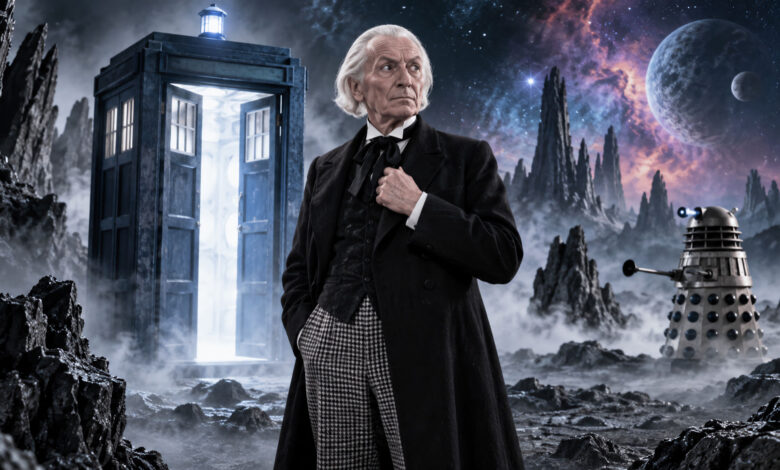
Before Doctor Who became a global franchise, it was a peculiar BBC family programme in which a mysterious old man abducted two schoolteachers, travelled through history in a faulty police box and encountered some argumentative pepper pots. It was not the most obvious recipe for television immortality, but immortality is rather the Doctor’s speciality.
The classic series follows the Doctor, an alien traveller from the planet Gallifrey who explores time and space inside the TARDIS. He is accompanied by an evolving collection of teachers, soldiers, journalists, scientists, aristocrats, robots and dangerously inquisitive teenagers. Together they visit humanity’s past, confront possible futures and repeatedly save planets whose inhabitants rarely seem adequately grateful.
Its defining idea is regeneration. When William Hartnell’s health made continuing impossible, the programme transformed its leading character into a new physical form played by Patrick Troughton. That inspired piece of invention allowed seven markedly different Doctors to lead the original run, ranging from mischievous cosmic wanderers to stern scientists, flamboyant bohemians and quietly manipulative strategists.
The production values fluctuate enormously, some social attitudes belong unmistakably to another age and dozens of early episodes remain missing from the BBC archive. Nevertheless, the surviving stories reveal a programme of extraordinary imaginative range. It could be historical drama one week, Gothic horror the next and an intergalactic political satire after tea. Even when the scenery wobbled, the ideas seldom stood still.
🎬 Transmission Details
- Show Title: Doctor Who: The Classic Series
- Years: 1963–1989
- Created By: Sydney Newman, C. E. Webber and Donald Wilson
- Network: BBC Television and BBC1
- Seasons: 26
- Episodes: 695
- Starring: William Hartnell, Patrick Troughton, Jon Pertwee, Tom Baker, Peter Davison, Colin Baker and Sylvester McCoy
- Supporting Cast: William Russell, Jacqueline Hill, Carole Ann Ford, Frazer Hines, Nicholas Courtney, Katy Manning, Elisabeth Sladen, Louise Jameson, Lalla Ward, Janet Fielding and Sophie Aldred
- Genre: Science fiction, adventure, fantasy and drama
- Status: Ended
🎯 Signal Strength
- IMDb: 8.4/10
- Rotten Tomatoes: 68% critics’ score and 80% audience score
- Skully’s take: Twenty-six seasons, seven Doctors and enough corridors to connect Gallifrey with Television Centre. Wildly inconsistent but endlessly inventive, classic Doctor Who remains one of television’s greatest triumphs of imagination over budget.
Ratings checked 19 September 2026 and may change.
📼 Spoiler Mode: Story Sync for Pub Chat
Major spoilers follow for all 26 seasons of the classic series, together with the 1996 television movie that connects it to the later revival.
Season 1 begins when teachers Ian Chesterton and Barbara Wright investigate their unusual pupil Susan Foreman. They discover that Susan lives in a police box with her grandfather, the Doctor, who activates the TARDIS and carries them all back to prehistoric Earth. Unable to control the ship properly, the travellers move through history and space, encountering the Daleks on the irradiated planet Skaro, becoming entangled with Marco Polo and Hernán Cortés, and escaping the French Revolution.
Season 2 expands the programme’s scale. The Daleks invade a future Earth, but after their defeat the Doctor allows Susan to remain behind with resistance fighter David Campbell. Orphaned Vicki joins the travellers, while Ian and Barbara finally find a route home when the Daleks pursue the TARDIS across time. Astronaut Steven Taylor becomes the Doctor’s next companion.
Season 3 is considerably darker. Vicki leaves during the fall of Troy, while temporary companions Katarina and Sara Kingdom both die during the Daleks’ immense plan to conquer the universe. Dodo Chaplet briefly joins the TARDIS before departing abruptly, Steven chooses to remain with an alien society, and Londoners Ben Jackson and Polly Wright become the Doctor’s new companions.
Season 4 changes the programme permanently. After confronting the Cybermen as they attempt to drain Earth’s energy into their dying world, the elderly Doctor collapses inside the TARDIS and transforms into a younger man. Initially suspicious, Ben and Polly accept that Patrick Troughton’s scruffier, more playful traveller is the same person. Highlander Jamie McCrimmon joins them, Ben and Polly return home, and Victorian orphan Victoria Waterfield takes their place.
Season 5 surrounds the Second Doctor with enduring adversaries. The travellers face Cybermen entombed on Telos, the robotic Yeti and their controlling Great Intelligence, the Ice Warriors, a fascist version of the Doctor’s friend Salamander and parasitic seaweed creatures. Victoria, exhausted by the danger, leaves the TARDIS, while astrophysicist Zoe Heriot joins Jamie and the Doctor.
Season 6 introduces UNIT through Brigadier Lethbridge-Stewart’s defence of Earth against a Cyberman invasion. The Doctor, Jamie and Zoe eventually become trapped in war zones created by renegade Time Lords. The Doctor summons his own people for help, but they place him on trial for interfering in history. Jamie and Zoe are returned home with most of their memories erased, while the Doctor is forced to regenerate and exiled to Earth.
Season 7 opens with the newly regenerated Third Doctor stranded on twentieth-century Earth. Working with UNIT, the Brigadier and scientist Liz Shaw, he confronts the Autons before discovering intelligent Silurians beneath the planet. Attempts at coexistence end in tragedy, while parallel-world experiments demonstrate how easily Earth can destroy itself. Liz leaves UNIT between seasons.
Season 8 introduces Jo Grant and the Master, a renegade Time Lord whose schemes dominate the year. He uses the Autons, manipulates a prison experiment, collaborates with alien invaders and eventually summons the demonic-looking Azal. Despite their hostility, the Doctor and the Master repeatedly display a reluctant connection as the only members of their species regularly stranded on Earth.
Season 9 gradually returns the Doctor to space. He encounters future humans rewriting history through Dalek-controlled time travel, visits the divided planet Peladon and battles the Sea Devils after the Master awakens them from hibernation. The Doctor’s attempts to repair the TARDIS lead into another of the Master’s elaborate plans involving Atlantis and the creature Kronos.
Season 10 celebrates the programme’s history by bringing the first three Doctors together against Omega, a legendary Time Lord trapped in an antimatter universe. As a reward, the Time Lords restore the Third Doctor’s ability to travel freely. Jo eventually falls in love with scientist Clifford Jones and leaves the Doctor after helping defeat pollution-mutated giant maggots and the corporate interests responsible for them.
Season 11 brings journalist Sarah Jane Smith aboard the TARDIS. The Doctor meets the warrior race known as the Sontarans, discovers dinosaurs roaming modern London and returns to Peladon during a political crisis. His confrontation with giant spiders on Metebelis Three exposes him to lethal radiation, leading to another regeneration as Sarah Jane and the Brigadier watch.
Season 12 introduces Tom Baker’s Fourth Doctor, whose eccentricity rapidly replaces UNIT formality with scarves, grins and unpredictability. Harry Sullivan joins the Doctor and Sarah Jane as they discover humanity’s future survivors aboard Nerva Beacon. The Time Lords send the trio to ancient Skaro, where the Doctor has an opportunity to prevent Davros from creating the Daleks but hesitates at committing genocide.
Season 13 embraces Gothic horror. The Doctor, Sarah and Harry encounter the Zygons and their shape-shifting infiltration of Earth before Harry leaves regular TARDIS travel. Ancient Sutekh nearly escapes imprisonment, Morbius attempts to restore himself to power and plant-based Krynoids threaten to consume humanity.
Season 14 separates the Doctor from Sarah Jane after the Time Lords summon him home. On Gallifrey, the Master frames him for assassination and attempts to access the Matrix. The Doctor later meets warrior Leela among the descendants of a failed expedition, and she joins him for encounters involving murderous robots, a sinister Victorian theatre and the time-travelling criminal Magnus Greel.
Season 15 introduces the robotic dog K9. The Doctor and Leela battle the Rutan-Sontaran war on a lighthouse island, enter the Doctor’s own body to defeat an intelligent virus and confront a dormant supernatural entity called the Fendahl. After a Sontaran invasion of Gallifrey is defeated, Leela remains behind with the Time Lord Andred, while K9 also elects to stay.
Season 16 follows the Doctor and a new Time Lady companion, Romana, as they search for the six segments of the Key to Time. The White Guardian claims the device is required to restore universal balance, but the Doctor ultimately scatters its pieces again after discovering that the Black Guardian intends to seize it. The artificial Princess Astra becomes the final segment before being restored to human form.
Season 17 begins with Romana regenerating into a form resembling Princess Astra. The Daleks return to Skaro seeking Davros, while a visit to Paris exposes Count Scarlioni as fragments of the alien Scaroth. The season was intended to conclude with Shada, involving a forgotten Time Lord prison and the ambitious Skagra, but industrial action prevented the story from being completed for broadcast.
Season 18 brings a more sombre atmosphere. The Doctor, Romana and K9 enter the pocket universe of E-Space, where teenager Adric joins them. Romana and K9 remain behind to help liberate an enslaved population, while Nyssa and Tegan Jovanka are drawn into the Master’s return. At Logopolis, the Master’s interference threatens the fabric of the universe, and the Fourth Doctor falls from a radio telescope before regenerating.
Season 19 follows the youthful Fifth Doctor as he recovers with the help of Adric, Nyssa and Tegan. Their uneasy travels include the Mara taking control of Tegan, the Great Fire of London and an encounter with a group of androids mistaken for humans. Adric sacrifices himself attempting to prevent a Cyberman-controlled spacecraft from striking Earth, but its altered course helps cause the extinction of the dinosaurs.
Season 20 explores the Doctor’s past. Omega attempts to enter the physical universe using the Doctor’s form, the Mara resurfaces on Manussa and former companion the Brigadier becomes entangled in a temporal accident. Turlough joins the TARDIS while secretly working for the Black Guardian, Nyssa leaves to help cure a deadly disease, and Turlough eventually rejects his murderous assignment. The anniversary special The Five Doctors brings multiple incarnations and companions to Gallifrey, where President Borusa seeks immortality.
Season 21 places increasing pressure on the Fifth Doctor and his friends. Tegan leaves after witnessing the violence of a Dalek conflict, while Turlough returns to his home planet after revealing his true identity. American student Peri Brown joins the Doctor, but exposure to a lethal toxin on Androzani Minor forces him to sacrifice the last antidote to save her. He regenerates into the volatile Sixth Doctor, whose unstable behaviour immediately frightens Peri.
Season 22 presents a louder and more confrontational Doctor. He faces Cybermen in London, challenges a corrupt entertainment system on Varos and encounters the Rani, another renegade Time Lord. Davros has begun converting human bodies into Daleks on Necros, while the Doctor’s relationship with Peri remains argumentative despite their growing loyalty. Complaints about violence and declining institutional support contribute to the programme being placed on an eighteen-month hiatus.
Season 23 turns that uncertainty into The Trial of a Time Lord. The Doctor is prosecuted by the Valeyard, who presents altered evidence from his adventures to condemn him. Peri apparently dies after her body is taken over, although it is later revealed that she survived and married King Yrcanos. The Master exposes the Valeyard as a possible future manifestation of the Doctor’s darker nature, and the Doctor departs with programmer Melanie Bush.
Season 24 begins with the Rani attacking the TARDIS and triggering the Doctor’s regeneration. The Seventh Doctor initially appears clownish and confused, but hints of calculation soon emerge. Mel leaves to travel with mercenary Sabalom Glitz, while teenager Ace joins the Doctor after being transported from contemporary Perivale to the distant planet Svartos.
Season 25 reveals the Seventh Doctor as a far more formidable strategist. He manipulates Davros and rival Dalek factions into using the Hand of Omega, destroying Skaro’s sun, before undermining a society controlled through compulsory happiness. His battles with the Cybermen and the Gods of Ragnarok suggest that apparent accidents are increasingly parts of carefully prepared plans.
Season 26 explores Ace’s history and the Doctor’s secretive methods. Morgaine invades Earth in pursuit of King Arthur, while a visit to Gabriel Chase exposes a disturbing event from Ace’s childhood. The Doctor uses Ace as bait to defeat the ancient Fenric, revealing that her arrival aboard the TARDIS was part of his enemy’s design. In Survival, the Master becomes trapped on a world whose predatory influence transforms its inhabitants. The Doctor and Ace escape, walking away towards further adventures as the original series quietly ends.
The 1996 television movie provides the bridge to the next era. The Seventh Doctor is shot after arriving in San Francisco and dies following an unsuccessful operation. He regenerates into the Eighth Doctor, who prevents the Master from using the TARDIS to steal his remaining lives and returns to travelling alone. The film does not produce a continuing television series, leaving the Doctor off-screen until the programme’s full revival in 2005.
🧠 Vibe Check
- 🚪 Every story can open onto a completely different genre, period or planet, provided the TARDIS remembers to land somewhere vaguely useful.
- 🎭 The Doctor changes dramatically between incarnations, but intelligence, curiosity, compassion and a deep suspicion of authority remain recognisable.
- 🏛️ Early seasons alternate futuristic adventures with educational historical stories before monsters and alien invasions gradually take precedence.
- 🕯️ The mid-1970s lean heavily into Gothic horror, bringing ancient gods, body horror, haunted houses and suspiciously atmospheric laboratories to teatime television.
- 🧪 The production frequently relies on inventive writing, performance and sound design to achieve effects that the budget cannot quite place on screen.
- 🪖 UNIT provides military action and a recurring Earthbound family, particularly during the Third Doctor’s years of exile.
- 🌀 Continuity grows increasingly elaborate, but most serials still offer a self-contained adventure that can be enjoyed without memorising Gallifreyan constitutional procedure.
Perfect if you like: Star Trek: The Original Series for optimistic science fiction built with theatrical ingenuity; The Twilight Zone for stories that reshape themselves around a fresh speculative idea; and Blake’s 7 for ambitious BBC science fiction willing to confront authority, sacrifice and moral compromise.
Worth knowing before you start: Watching all 695 episodes is an expedition rather than a casual binge. Pacing is much slower than modern television, stories were designed to unfold weekly and some six-part serials could lose an episode without anyone reaching the other end of the corridor. Sampling highly regarded stories from each Doctor is a perfectly respectable way to begin.
The BBC discarded numerous early recordings after broadcast. Following the recovery of two instalments in 2026, 95 episodes remain missing from the archive. Many incomplete stories can still be followed through surviving audio recordings, photographic reconstructions and official animated versions.
🚀 Why It’s a Sci-Fi Icon
Classic Doctor Who did more than survive changing fashions and limited resources. It created a television format capable of replacing its star, reinventing its tone and travelling virtually anywhere without abandoning its central identity.
- ♻️ Regeneration transformed a production crisis into the programme’s greatest creative strength. Recasting the Doctor became part of the story, allowing each performer to reinterpret the role while preserving a continuous character and mythology.
- 🟦 The TARDIS remains one of science fiction’s most ingenious narrative devices. Its faulty exterior became an instantly recognisable British icon, while its limitless interior offered a doorway to any historical period, alien world or speculative future.
- 🧂 The programme created monsters that escaped the confines of children’s television. The Daleks, Cybermen, Sontarans, Autons and Davros became enduring cultural figures because they represented fascism, dehumanisation, militarism and uncontrolled scientific ambition as well as providing something alarming to place at the end of a corridor.
- 🌌 Its format made science fiction effectively limitless. Historical drama, invasion thriller, political satire, space opera, Gothic horror, comedy and surreal fantasy could all coexist beneath the same title sequence.
- 🎛️ Its production teams turned scarcity into a recognisable creative style. Electronic music, experimental video effects, theatrical sets and radiophonic soundscapes produced an atmosphere that expensive realism could not necessarily have improved.
- 🇬🇧 It embedded science fiction within British popular culture. The Doctor’s preference for intelligence over force, combined with a willingness to challenge governments, corporations and empires, established a distinctly British alternative to conventional space-faring heroes.
🔦 Deep Dive Highlights
- 🧓 The seven classic Doctors: William Hartnell’s irritable wanderer, Patrick Troughton’s deceptively foolish schemer, Jon Pertwee’s elegant action hero, Tom Baker’s alien bohemian, Peter Davison’s vulnerable idealist, Colin Baker’s theatrical provocateur and Sylvester McCoy’s calculating strategist each reveal a different facet of the same traveller.
- 👥 The companions: Ian and Barbara give the earliest stories their moral centre, Jamie becomes the Second Doctor’s steadfast friend, Sarah Jane matches curiosity with courage, and Ace’s troubled history allows the Seventh Doctor’s stories to explore the consequences of his manipulation.
- 🪖 UNIT and the Brigadier: Nicholas Courtney’s Lethbridge-Stewart provides continuity across multiple Doctors. His practical military instincts regularly clash with the Doctor’s pacifism, but their friendship becomes one of the programme’s most dependable relationships.
- 🤖 The Daleks and Cybermen: The Daleks reduce life to racial purity and conquest, while the Cybermen sacrifice emotion in pursuit of survival. Their effectiveness varies between stories, but the ideas behind them remain unsettling.
- 🕴️ The Master: Introduced as the Doctor’s intellectual equal and moral opposite, the Master combines murderous ambition with the faint suggestion that defeating the Doctor would be considerably less enjoyable than continuing their rivalry.
- 🎶 The Radiophonic Workshop: Delia Derbyshire’s realisation of Ron Grainer’s theme remains astonishing, while electronic scores and carefully constructed effects give alien worlds an identity before the scenery has even appeared.
- 🏺 The historical adventures: Stories such as The Aztecs, The Romans and The Massacre demonstrate that history itself can provide danger and moral complexity without requiring an alien invasion to liven things up.
- 📼 The missing episodes: The gaps in the archive remain painful, but surviving soundtracks, telesnaps, animations and continuing discoveries have created a remarkable culture of restoration around the programme.
Skully's independent editorial rating A gloriously uneven monument to television imagination, classic Doctor Who can move from profound drama to painted bubble wrap without changing its expression. At its best, few science-fiction programmes have been braver, stranger or more influential.Skully's Score
What works
What may not
Recommended Sci-Fi TV Products
Watch The Expanse on Prime Video
Amidst political tension between Earth, Mars and the Belt, the single greatest conspiracy of all time must be unravelled.
Watch Now!
Watch The X-Files on Prime Video
A young FBI agent is assigned watchdog duty over a fellow agent, but finds herself drawn into his investigations of paranormal and unexplained phenomena.
Watch Now!
Watch Fallout on Prime Video
Based on one of the greatest video games of all time, Fallout is the story of haves and have-nots in a world in which there’s almost nothing left to have.
Watch Now!As an Amazon Associate I earn from qualifying purchases.