✨ Byte-Sized Overview
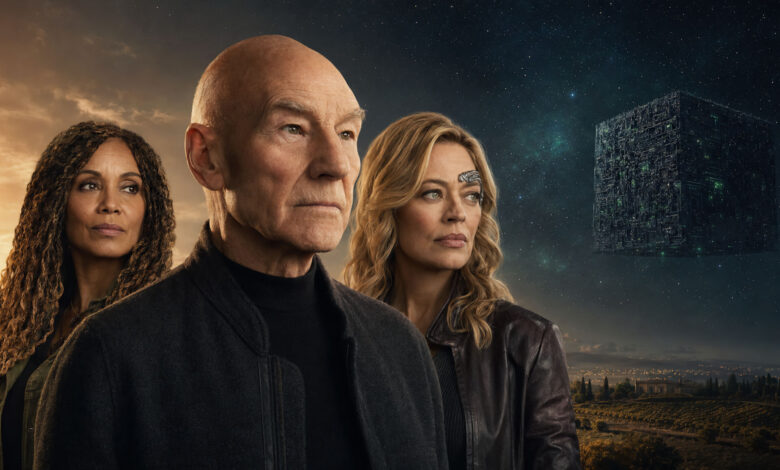
Retirement should be straightforward when you own a vineyard in rural France. A little winemaking, a faithful dog, perhaps the occasional argument about archaeology. Unfortunately, Jean-Luc Picard has unfinished business with practically half the galaxy.
Star Trek: Picard follows the former Enterprise captain into a later chapter of his life, where his reputation remains formidable but his relationship with Starfleet has fractured. When a young woman arrives asking for help, he finds himself confronting questions he thought he had left behind: what makes someone a person, what we owe those we have failed, and whether it is ever too late to make things right.
This isn’t simply The Next Generation with older faces. Its three seasons take markedly different approaches, moving from a synthetic-life conspiracy to a time-travelling personal reckoning and, finally, a reunion with the Enterprise family.
The results are uneven, sometimes frustrating and frequently moving. At its best, the series remembers that Picard’s greatest strength was never commanding a starship. It was recognising the humanity in someone everyone else had dismissed.
🎬 Transmission Details
- Show title: Star Trek: Picard
- Years: 2020–2023
- Created by: Akiva Goldsman, Michael Chabon, Kirsten Beyer and Alex Kurtzman
- Network (US): CBS All Access, subsequently Paramount+
- Network (UK): Amazon Prime Video; also Paramount+ from 2023
- Seasons: 3
- Episodes: 30
- Starring: Patrick Stewart, Jeri Ryan, Michelle Hurd, Alison Pill, Isa Briones, Santiago Cabrera, Evan Evagora, Orla Brady and Brent Spiner. Later seasons also feature Jonathan Frakes, Marina Sirtis, Gates McFadden, LeVar Burton, Michael Dorn, Ed Speleers and Todd Stashwick.
Viewing note: Start with “Remembrance” and watch in release order. Familiarity with The Next Generation adds considerable emotional weight, while Star Trek: Nemesis provides important background that the first season openly discusses. Voyager helps with Seven of Nine’s history, but you don’t need to complete an entire Starfleet syllabus before beginning. Each season tells a largely distinct ten-episode story, with the third bringing the series to a conclusion.
🎯 Signal Strength
- IMDb: 7.5/10
- Rotten Tomatoes: 89% critics / 57% audience — series averages
- Skully’s take: Retirement was supposed to involve grapes and a dog. Somehow it became conspiracies, time travel and another urgent conversation with the Borg. Starfleet clearly needs a better pension scheme.
📼 Spoiler Mode: Story Sync for Pub Chat
Major spoilers ahead for all three seasons, plus important events from the Next Generation films.
The story begins in 2399, twenty years after the events of Star Trek: Nemesis. Jean-Luc Picard has retired to his family vineyard, carrying the weight of Data’s sacrifice and his own bitter departure from Starfleet.
Their falling-out followed a catastrophic attack on Mars by synthetic workers. The disaster destroyed the fleet being assembled to evacuate Romulans from their threatened home system. Starfleet abandoned the rescue effort, synthetic life was banned, and Picard resigned in protest.
His isolation ends when Dahj, a frightened young woman with extraordinary abilities, asks for his protection. After she is killed, Picard discovers that she had a twin, Soji, and that both are synthetic beings connected to Data’s neural legacy.
Unable to secure Starfleet’s support, he gathers an unconventional crew aboard the civilian ship La Sirena. Pilot Cristóbal Rios, former colleague Raffi Musiker, scientist Agnes Jurati and Romulan warrior Elnor join the mission, with Seven of Nine becoming a crucial ally.
The investigation exposes a Romulan conspiracy behind the Mars attack and leads to Coppelius, home to a community of advanced synthetics. Faced with destruction, the colony considers summoning powerful synthetic beings whose intervention would threaten organic life. Picard persuades Soji to choose trust over annihilation.
The victory costs him his life: a terminal neurological condition finally overwhelms him. His consciousness is transferred into a synthetic body designed to preserve an ordinary, finite lifespan. During the process, he encounters a preserved version of Data’s consciousness and honours his friend’s request to be allowed to die.
Season two changes direction when Q places Picard and his companions in an altered reality dominated by a ruthless, authoritarian Confederation. To repair history, they travel to Los Angeles in 2024, where Picard’s ancestor Renée must take part in a pivotal space mission.
Alongside the historical crisis runs a more personal story. Picard confronts buried memories surrounding his mother’s death and the guilt that has shaped his reluctance to let others get close. Q’s challenge becomes an unexpected expression of affection, pushing his old adversary towards a life less governed by fear.
Meanwhile, Jurati’s merging with a Borg Queen produces a separate Borg faction built around cooperation rather than conquest. That distinction matters: the traditional Collective has not suddenly become everyone’s helpful neighbour.
Season three begins with a distress call from Beverly Crusher. Picard and Riker board the USS Titan-A, commanded by the abrasive Liam Shaw, with Seven serving as first officer. They discover that Beverly’s son, Jack Crusher, is also Picard’s son.
A conspiracy involving rogue Changelings conceals a renewed Borg threat. Organic changes left behind by Picard’s assimilation as Locutus were inherited by Jack. Using Picard’s original body, the conspirators have also manipulated transporter systems to introduce Borg alterations into younger Starfleet personnel.
During Frontier Day, Jack becomes the means of activating their assimilation, while Starfleet’s interconnected ships turn against their own people.
The reunited Enterprise crew respond aboard Geordi La Forge’s restored Enterprise-D, which operates outside the compromised fleet network. Picard enters the Collective to reach Jack, finally connecting with him as a father rather than approaching him as another problem to solve.
The Borg threat is defeated, the affected crews are restored, and Seven takes command of the Titan-A, now renamed the Enterprise-G. Picard’s old friends finish where they belong: around a poker table, sharing another hand.
After all the cosmic danger, the final destination is friendship.
🧠 Vibe Check
- 🖖 A legendary captain confronting age, regret and unfinished business
- 🧩 Serialised mysteries involving synthetic life, secret agendas and shifting identities
- 👥 Found families, complicated relationships and friendships that survive decades
- 🚀 Modern space spectacle with a strong emotional connection to classic Trek
Perfect if you like: Star Trek: The Next Generation for its characters and ethical questions, Star Trek: Voyager for Seven of Nine’s continuing journey, or Star Trek: Discovery for season-long mysteries and cinematic presentation. Just expect more personal baggage than a routine Enterprise mission usually allowed.
🚀 Why It’s a Sci-Fi Icon
- 🧓 It lets a legendary hero grow older: Picard is no longer the unquestioned authority at the centre of a smoothly functioning bridge. He can be isolated, stubborn and wrong. Watching him negotiate a world that has moved on gives the series a different perspective from stories built around endlessly rejuvenated action heroes.
- 🤖 It returns to Trek’s questions about personhood: Artificial life is more than futuristic decoration here. The series asks whether memory, love and moral choice can make someone a person, and what happens when governments decide that an entire category of beings is too dangerous to deserve rights.
- 🏛️ It challenges the institution Picard believed in: Starfleet remains an ideal worth defending, but its actions do not automatically deserve his loyalty. The tension between institutional authority and personal conscience gives the early story its strongest material, particularly when humanitarian commitments become politically inconvenient.
- 🦾 It gives Seven of Nine a life beyond Voyager: Seven has spent years outside the protective structure of her former crew. Her experiences have made her tougher and less patient with respectable excuses for cruelty. Jeri Ryan preserves the character’s precision while revealing a more openly wounded, independent adult.
- 🌌 It connects different generations of Trek: The series draws on The Next Generation, Voyager, the films and the wider franchise’s political history. Those connections work best when they shape relationships and choices, rather than simply asking viewers to applaud a familiar name or recognise something in the background.
- ❤️ It understands the value of an ensemble: The final season’s strongest asset is not merely getting familiar actors into the same room. It is allowing their characters to retain recognisable rhythms: affectionate teasing, old disagreements, professional trust and the comfort of being understood without having to explain yourself.
🔦 Deep Dive Highlights
- 🖖 Jean-Luc Picard: Patrick Stewart plays a man whose conviction has survived more reliably than his peace of mind. This Picard still delivers a formidable speech, but the quieter scenes often reveal more: hesitation before reaching out, discomfort with vulnerability, and the gradual recognition that accepting help is not a failure of leadership.
- 🦾 Seven of Nine: Neither simply a former Borg nor a convenient reminder of Voyager, Seven brings practical experience and moral impatience to the story. She understands what exclusion looks like from the receiving end. Her developing relationship with Starfleet becomes a useful test of whether the organisation can live up to its own principles.
- 🧩 Raffi Musiker: Brilliant, suspicious and carrying considerable personal damage, Raffi is one of the series’ most grounded characters. Her history with Picard includes loyalty and resentment in almost equal measure. Michelle Hurd makes her more than the person who uncovers conspiracies: she is someone trying to rebuild trust while struggling to trust herself.
- 🤖 Data and Synthetic Life: Data’s legacy runs through the series even when he is not physically present. Soji and Jurati bring different perspectives to questions about artificial consciousness, responsibility and belonging. The most interesting material treats synthetic existence as a lived experience, not merely a technological puzzle for the human characters to solve.
- 👥 The Next Generation Crew: Riker, Troi, Crusher, La Forge and Worf return with lives that have continued beyond the Enterprise. Parenthood, loss, responsibility and changing priorities have left their marks. The pleasure lies in seeing what has changed without losing the personalities—and occasionally ridiculous conversational habits—that made them a family.
- 🚀 La Sirena and the Titan: The ships reflect the series’ changing identity. La Sirena is an intimate civilian vessel populated by people without a shared rulebook; the Titan-A restores the structure of a Starfleet bridge. Moving between those environments lets Picard operate both as an outsider assembling allies and as a veteran navigating an institution he knows intimately.
Star Trek: Picard does not always make the cleanest journey between its ideas. Its pacing wobbles, and its three seasons can feel like competing versions of the same project. But when it trusts its characters, it offers something worth returning for: a reminder that exploration does not end when you grow older, and neither does the possibility of finding your way home.
Recommended Sci-Fi TV Products
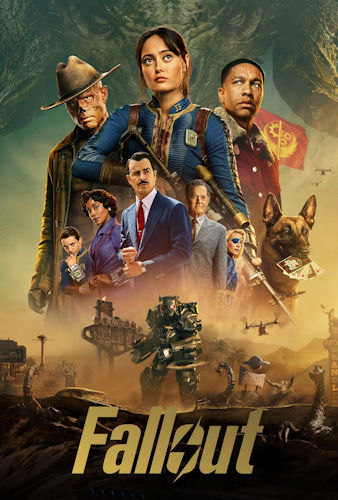
Watch Fallout on Prime Video
Based on one of the greatest video games of all time, Fallout is the story of haves and have-nots in a world in which there’s almost nothing left to have.
Watch Now!
Watch The X-Files on Prime Video
A young FBI agent is assigned watchdog duty over a fellow agent, but finds herself drawn into his investigations of paranormal and unexplained phenomena.
Watch Now!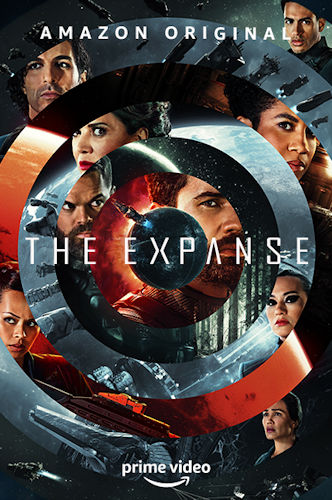
Watch The Expanse on Prime Video
Amidst political tension between Earth, Mars and the Belt, the single greatest conspiracy of all time must be unravelled.
Watch Now!As an Amazon Associate I earn from qualifying purchases.