✨ Byte-Sized Overview
Before superhero television required a flowchart of interconnected films, spin-offs and alternate universes, Heroes asked a disarmingly simple question: what would happen if ordinary people suddenly discovered that they could fly, heal, read minds or bend time? The answer involved secret organisations, prophetic paintings, endangered cheerleaders and an alarming number of visits to New York City.
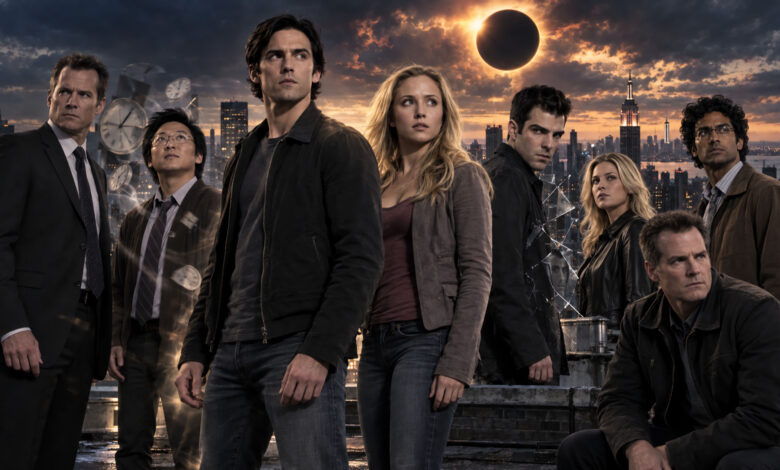
The sprawling ensemble includes Peter Petrelli, a compassionate nurse who believes he can absorb other people’s abilities; Claire Bennet, a teenager who can recover from almost any injury; Hiro Nakamura, an office worker delighted to discover that he can manipulate time; and Mohinder Suresh, a geneticist investigating his father’s research into human evolution. Their initially separate lives gradually converge around a threatened catastrophe and the murderous figure known as Sylar.
At its best, Heroes combines the accessibility of a comic book with the structure of a mystery thriller. Powers reveal something about the people who possess them, while intersecting storylines create the feeling that a much larger design is slowly becoming visible. The first season remains the programme’s high point, driven by memorable characters, strong cliffhangers and one of television’s most effective promotional phrases: “Save the cheerleader, save the world.”
Later seasons struggle to maintain that discipline. Characters change allegiance with remarkable enthusiasm, abilities expand or disappear according to the needs of the week, and death gradually becomes more of a scheduling inconvenience than a permanent condition. The original series was cancelled after its fourth season, leaving its final development unresolved, although the separate 2015 continuation Heroes Reborn later explored some of its consequences.
🎬 Transmission Details
- Show Title: Heroes
- Years: 2006–2010
- Created By: Tim Kring
- Network: NBC
- Seasons: 4
- Episodes: 78
- Starring: Milo Ventimiglia, Masi Oka, Hayden Panettiere, Sendhil Ramamurthy, Adrian Pasdar, Jack Coleman
- Supporting Cast: Ali Larter, Greg Grunberg, Zachary Quinto, James Kyson Lee, Cristine Rose, Robert Knepper
- Genre: Science fiction, Superhero drama, Fantasy, Thriller
- Status: Cancelled
🎯 Signal Strength
- IMDb: 7.5/10
- Rotten Tomatoes: 52% average critics’ score
- Skully’s take: The first season saves the cheerleader, threatens the world and makes network superhero drama feel genuinely exciting. Later seasons occasionally appear to have absorbed the special ability to forget what worked.
Ratings checked 5 September 2026 and may change.
📼 Spoiler Mode: Story Sync for Pub Chat
Major spoilers for all four seasons follow, including the original series ending.
Geneticist Mohinder Suresh travels to New York after the murder of his father, Chandra, who had been researching people with extraordinary abilities. Mohinder initially doubts parts of Chandra’s work but soon discovers that his father had identified individuals around the world whose genetic development appears to represent a new stage in human evolution.
Among them is Peter Petrelli, a hospice nurse who dreams that he can fly. Peter initially believes the ability belongs to him, but it is his ambitious politician brother Nathan who can fly. Peter’s real power allows him to absorb or reproduce the abilities of people around him, making his potential far greater and considerably more dangerous.
In Texas, cheerleader Claire Bennet secretly tests her extraordinary regenerative ability with the help of her friend Zach. Claire’s adoptive father, Noah Bennet, works for a clandestine organisation known as the Company, which tracks, studies and sometimes imprisons evolved humans. Although Noah has committed terrible acts for the organisation, his first priority becomes protecting Claire from both the Company and anyone seeking to exploit her power.
Japanese office worker Hiro Nakamura discovers that he can stop time and teleport. After transporting himself several weeks into the future, he witnesses New York being destroyed by a massive explosion. Hiro returns determined to prevent the catastrophe, accompanied by his loyal friend Ando Masahashi. A comic book drawn by precognitive artist Isaac Mendez appears to document events before they occur, effectively providing Hiro with instructions for becoming the hero he has always wanted to be.
Police officer Matt Parkman develops telepathy, while Niki Sanders displays a violent alternate personality named Jessica with superhuman strength. Niki’s estranged husband D.L. Hawkins can pass through solid matter, and their son Micah can communicate with electronic systems. Their troubled family becomes connected to businessman Daniel Linderman, one of the Company’s founders and a man determined to manipulate the coming disaster.
The greatest immediate threat is Gabriel Gray, a watchmaker who becomes the serial killer Sylar. Driven by a desire to feel special, Sylar uses his intuitive understanding of complex systems to examine the brains of evolved humans and acquire their abilities. He murders Chandra Suresh after Chandra rejects him, then begins hunting other people from the professor’s list.
Peter saves Claire from Sylar at her school’s homecoming celebration, fulfilling the first half of Hiro’s warning. However, Claire is not carrying the power that causes the predicted explosion. Peter absorbs the radioactive ability of Ted Sprague and begins losing control of it during the confrontation at Kirby Plaza.
Linderman has been engineering events because he believes the destruction of New York will unite the world behind Nathan. He arranges Nathan’s election, with Micah forced to manipulate the voting system, but is killed by D.L. before his wider plan can be completed. Hiro stabs Sylar, apparently stopping him, although Sylar escapes through the city’s sewers.
As Peter begins to explode, Nathan abandons his political ambitions and flies his brother high above the city. Peter detonates harmlessly in the sky, and both brothers survive. Hiro, meanwhile, accidentally teleports to seventeenth-century Japan, where he meets his childhood hero Takezo Kensei.
Season 2 begins four months later. Kensei is revealed to be an Englishman named Adam Monroe whose regenerative ability has allowed him to survive for centuries. Hiro initially helps Adam become the legendary warrior described in history, but their friendship collapses over Yaeko, the woman they both love. Adam comes to blame Hiro for destroying his life.
Peter has survived the explosion but awakens in Ireland with no memory. He begins a relationship with Caitlin and is eventually transported into a future devastated by the Shanti virus, a disease capable of killing most of humanity. Determined to prevent that future, Peter allies himself with Adam without understanding Adam’s true objective.
The Company is experimenting with treatments for evolved humans while several of its founders are being murdered. Mohinder works with Noah to undermine the organisation from within, but their partnership deteriorates as Noah becomes increasingly ruthless. Noah is shot while trying to protect Claire, then revived using a transfusion of her regenerative blood.
Maya Herrera travels from Central America with her twin brother Alejandro, seeking help for an ability that releases a deadly poison whenever she becomes distressed. Sylar, temporarily deprived of his powers, manipulates Maya and murders Alejandro. He later obtains Claire’s blood, which restores his abilities.
Niki joins the Company in search of treatment and later dies while rescuing Monica Dawson from a burning building. Monica possesses adaptive muscle memory, allowing her to reproduce any physical action she observes, but her promising storyline ends with the shortened season.
Adam plans to release the Shanti virus, believing humanity must be devastated before it can build a better world. Peter realises he has been deceived and destroys the virus before it can spread. Hiro confronts Adam and teleports him into a coffin buried in a cemetery, condemning the immortal man to remain trapped underground.
Nathan prepares to reveal the existence of evolved humans during a press conference, but an unseen assailant shoots him before he can speak. The season ends abruptly after eleven episodes, its planned story curtailed by the 2007–08 writers’ strike.
Season 3 opens with the revelation that Nathan’s attacker was a future version of Peter attempting to prevent the disastrous consequences of public disclosure. His intervention helps create a different crisis when dangerous prisoners escape from the Company’s Level 5 facility.
Angela Petrelli assumes control of the Company and claims that Sylar is another of her sons. Noah reluctantly works alongside him, while Sylar briefly attempts to control his murderous hunger. Angela’s story is a manipulation, but it encourages Sylar to believe he could belong to the Petrelli family.
The real Petrelli patriarch, Arthur, is alive and leading a rival organisation called Pinehearst. Arthur can steal abilities permanently and strips Peter of his powers. He recruits evolved humans while developing a formula capable of granting abilities to ordinary people.
Mohinder injects himself with an imperfect version of the formula. He gains enhanced strength and agility but develops disturbing physical mutations and increasingly erratic behaviour. The scientist who once approached abilities through evidence has apparently decided that laboratory safety procedures are for people without their own opening credits.
Hiro and Ando pursue the formula while Matt falls in love with speedster Daphne Millbrook. Nathan becomes convinced that synthetic abilities could be used to create an organised force of superhuman soldiers and temporarily supports Pinehearst. Sylar eventually kills Arthur, while Peter and Nathan’s confrontation destroys the facility.
Hiro prevents the formula from being widely distributed, although Ando receives an ability that amplifies the powers of others. Peter injects himself with the completed formula to save Nathan and regains a limited version of his original power, allowing him to retain one borrowed ability at a time.
The second half of Season 3, titled Fugitives, begins when Nathan informs the United States government about evolved humans. Homeland Security agent Emile Danko leads a covert operation to capture them, forcing Peter, Claire, Hiro, Ando, Matt and Mohinder into hiding.
Nathan gradually loses control of the programme as Danko adopts increasingly brutal methods. Sylar infiltrates the operation using a shape-shifting ability and searches for his biological father, Samson Gray, only to find a dying man as predatory as himself.
Sylar kills Nathan and assumes his appearance. Unable to accept Nathan’s death or the political consequences it could create, Angela and Noah persuade Matt to implant Nathan’s memories and personality into Sylar’s mind. Sylar consequently believes he is Nathan, while his real identity remains buried beneath the mental conditioning.
Season 4 follows the characters attempting to build ordinary lives. Claire begins university and forms a close relationship with her roommate Gretchen Berg, while Peter works as a paramedic and uses his ability to save people. Hiro learns that he has a terminal brain tumour and begins revisiting moments from his past, hoping to correct regrets before he dies.
The principal threat comes from Samuel Sullivan, the leader of a travelling carnival populated by evolved humans. Samuel can manipulate earth and stone, with the strength of his ability increasing when other powered people gather around him. He presents the carnival as a refuge from persecution while secretly drawing more people into his orbit.
Samuel manipulates Hiro into changing history and uses him to recover people who can strengthen the carnival. Hiro rescues Charlie Andrews from Sylar, but Samuel sends her back to 1944. Hiro later encounters an elderly Charlie who has lived a complete and happy life, allowing him to accept that saving someone does not always mean restoring the future he expected.
The personality implanted in Sylar begins to break down. Believing he is Nathan, he seeks help from Peter before eventually confronting the truth of Nathan’s death. Nathan’s consciousness accepts that it cannot continue, leaving Sylar in control of his own body again.
Sylar asks Matt to remove his powers and murderous impulses. Matt instead traps him within a mental prison, but Peter enters Sylar’s mind to retrieve him when his help becomes necessary. They experience years of subjective isolation together, during which Sylar begins developing genuine empathy.
Samuel plans to expose evolved humans by killing thousands of people in Central Park and presenting himself as their saviour. Noah is imprisoned beneath the carnival but rescued after Claire publicly rejects Samuel’s leadership. Hiro teleports the other carnival residents away, weakening Samuel enough for Peter to defeat him.
Sylar helps save the crowd, demonstrating that he may finally have chosen a different path. Claire then decides that continued secrecy is impossible. In front of television cameras, she climbs to the top of a Ferris wheel, jumps and regenerates after striking the ground.
Her public demonstration begins a new volume titled Brave New World, but the series was cancelled before that story could be told. Heroes Reborn later depicts a world in which evolved humans have become publicly known, although several original characters and unresolved relationships do not return.
🧠 Vibe Check
- 🦸 Ordinary people discovering extraordinary abilities rather than established costumed superheroes
- 🧩 Interlocking mysteries, prophetic visions and cliffhangers designed for weekly speculation
- 🌍 A large international ensemble gradually drawn towards shared threats
- 🎨 Comic-book framing, chapter titles and visual storytelling woven into live-action drama
- 🧬 Science-fiction ideas about mutation, inheritance and the next stage of human evolution
- 🕵️ Secret organisations tracking people whose abilities may be useful or dangerous
- 🎢 A sharp decline in narrative discipline after an enormously compelling opening season
Perfect if you like: The 4400 for ordinary people developing unexplained abilities, Sense8 for a geographically scattered ensemble becoming connected, or X-Men for conflict surrounding the emergence and treatment of a changed human population.
Worth knowing before you start: The first season tells a largely satisfying story and can be enjoyed on its own. Subsequent seasons contain worthwhile performances and individual episodes, but repeated reversals, resurrected characters and shifting mythology make the overall experience considerably less consistent.
Watch the original four seasons before Heroes Reborn. The continuation assumes knowledge of the original characters and of the social change initiated by the final scene, although it does not resolve every dangling storyline.
🚀 Why It’s a Sci-Fi Icon
Heroes may also be remembered as one of television’s great missed opportunities, but its uneven later years should not erase the impact of its debut. In 2006, a heavily serialised network drama about ordinary people developing powers felt fresh, ambitious and genuinely eventful.
- 📺 It helped establish superhero drama as mainstream television. The series reached a broad network audience before interconnected comic-book universes became a routine part of the television landscape.
- 🧑🤝🧑 Its ensemble made superhuman abilities feel personal. Powers emerged through family pressures, professional frustrations and questions of identity rather than through costumes and public heroism.
- 🗯️ Its comic-book presentation gave the programme a distinctive identity. Chapter titles, artwork, prophetic images and serialised volumes created the sensation of watching an unfolding graphic novel without simply imitating panels on screen.
- ⏱️ Its first season remains an excellent example of converging storytelling. Separate characters and locations gradually connect around one central threat, with repeated phrases and images building anticipation across more than twenty episodes.
- 🌐 Its wider storytelling embraced the online culture of its era. Web content, graphic novels and interactive material expanded the mythology at a time when television networks were still experimenting with transmedia storytelling.
- ⚠️ Its decline became an instructive part of its legacy. Heroes demonstrated how quickly a mystery-driven series can lose momentum when consequences are reversed and character motivations become subordinate to constant twists.
🔦 Deep Dive Highlights
- 🩺 Peter Petrelli: Milo Ventimiglia gives Peter a fundamental decency that anchors the first season. His desire to help people remains compelling even when the rules governing his abilities become frustratingly flexible.
- ⏱️ Hiro Nakamura: Masi Oka brings delight, optimism and emotional sincerity to a programme frequently occupied by catastrophe. Hiro understands heroism through comics but gradually learns that courage is rather less tidy in practice.
- 🧬 Claire Bennet: Hayden Panettiere balances teenage vulnerability with the physical fearlessness created by Claire’s regenerative ability. Her struggle for control over her identity provides one of the series’ strongest continuing threads.
- 🕶️ Noah Bennet: Jack Coleman turns an apparently anonymous company man into one of the drama’s most layered characters. Noah can be protective, manipulative, frightening and unexpectedly tender, sometimes within the same conversation.
- ⌚ Sylar: Zachary Quinto gives the series a memorable villain whose hunger for abilities grows from resentment and a desperate need to feel significant. Later attempts to reposition him are uneven, but Quinto remains consistently watchable.
- 🔬 Mohinder Suresh and the evolutionary mystery: Mohinder provides the original bridge between scientific investigation and the emerging population of powered people. His narration helps give the first season a sense of wonder that becomes harder to sustain later.
- 🎨 Isaac Mendez’s paintings: Prophetic artwork converts future events into striking visual clues. The paintings allow characters and viewers to see possible outcomes without necessarily understanding the path leading towards them.
- 🏢 The Company: The organisation gives the programme an effective source of institutional ambiguity. Its members can protect, exploit or imprison evolved humans, often while insisting that all three actions are necessary.
Skully's independent editorial rating A landmark superhero drama with an outstanding opening season, memorable characters and enough later flashes of brilliance to make its decline frustrating rather than fatal.Skully's Score
What works
What may not
Recommended Sci-Fi TV Products
Watch Fallout on Prime Video
Based on one of the greatest video games of all time, Fallout is the story of haves and have-nots in a world in which there’s almost nothing left to have.
Watch Now!
Watch The Walking Dead on Prime Video
County Sheriff Rick Grimes, his wife, son and a small eclectic group try to survive constant attacks from zombies and other threats.
Watch Now!
Watch The Expanse on Prime Video
Amidst political tension between Earth, Mars and the Belt, the single greatest conspiracy of all time must be unravelled.
Watch Now!As an Amazon Associate I earn from qualifying purchases.