✨ Byte-Sized Overview
One unidentified body turning up in Whitechapel is an ordinary murder mystery. The same body appearing in exactly the same place in four different years is rather more inconvenient, particularly when the investigating detectives are separated by more than a century.
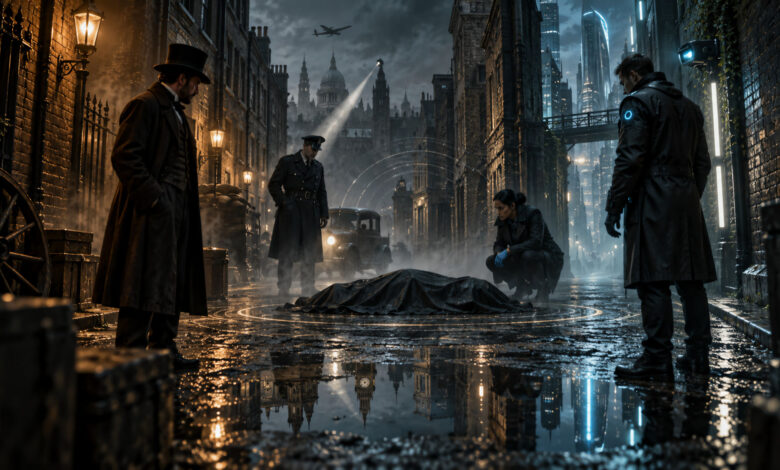
Bodies follows four London police officers working in 1890, 1941, 2023 and 2053. DI Alfred Hillinghead investigates amid Victorian repression and institutional hypocrisy; DS Charles Whiteman navigates wartime London while concealing secrets of his own; DS Shahara Hasan encounters the body after pursuing a suspect through a contemporary far-right demonstration; and DC Iris Maplewood finds its living counterpart in an authoritarian future shaped by a devastating national tragedy.
Each timeline initially operates as its own police drama, complete with a distinctive visual identity, social pressures and investigative obstacles. Gradually, shared evidence, repeated symbols and the phrase “Know You Are Loved” reveal a conspiracy built across generations. What begins as four murder cases becomes an examination of predestination, political manipulation and whether a person raised to fulfil a terrible purpose can choose a different life.
Adapted from Si Spencer’s Vertigo graphic novel, Bodies is dense without being wilfully impenetrable. It demands attention, particularly once relatives, identities and recordings begin travelling through the family tree, but its emotional logic remains clear. The complete eight-episode limited series tells a largely self-contained story, although its final moments leave one small temporal eyebrow raised.
🎬 Transmission Details
- Show Title: Bodies
- Years: 2023
- Created By: Paul Tomalin
- Network: Netflix
- Seasons: 1
- Episodes: 8
- Starring: Amaka Okafor, Kyle Soller, Jacob Fortune-Lloyd, Shira Haas and Stephen Graham
- Supporting Cast: Tom Mothersdale, George Parker, Synnøve Karlsen, Greta Scacchi, Gabriel Howell and Michael Jibson
- Genre: Science-fiction mystery thriller, crime drama and time travel
- Status: Ended
🎯 Signal Strength
- IMDb: 7.3/10
- Rotten Tomatoes: 81% critics’ score
- Skully’s take: Four detectives, four eras and one corpse with a truly unreasonable commitment to punctuality. The puzzle is elaborate, but the human need beneath it gives the machinery real weight.
Ratings checked 17 September 2026 and may change.
📼 Spoiler Mode: Story Sync for Pub Chat
Spoiler warning: This section reveals the complete story, identities, deaths and ending of the limited series.
In 2023, DS Shahara Hasan discovers the naked body of quantum physicist Gabriel Defoe in Longharvest Lane after pursuing Syed Tahir from a far-right demonstration. Syed insists that he did not kill the man and subsequently takes his own life. Hasan’s investigation leads to Elias Mannix, a vulnerable teenager raised by Andrew and Elaine Morley. The Morleys belong to a secret organisation whose members repeatedly use the phrase “Know You Are Loved”. Hasan eventually discovers that Elias is expected to detonate a nuclear bomb hidden beneath Harker Bank. The explosion kills approximately half a million people and creates the traumatised society from which Elias’s future regime will emerge.
The same body was found in 1890 by DI Alfred Hillinghead. His investigation brings him into contact with photographer Henry Ashe, with whom he begins a relationship that could destroy both men in Victorian society. Their evidence points towards wealthy banker Sir Julian Harker. Harker frames Hillinghead by arranging compromising photographs involving Defoe’s corpse, then blackmails him into accusing Ashe. Hillinghead ultimately confesses his sexuality to his family and accepts responsibility for the murder to protect Ashe. Harker later has him killed while he is being transported to prison.
In 1941, DS Charles Whiteman is ordered to remove Defoe’s body before it can be investigated. Whiteman, whose real surname is Weissman, has survived antisemitism and wartime corruption by becoming useful to dangerous people. His initial attempt to conceal the corpse fails, and a young witness named Esther becomes his responsibility. When the conspiracy murders Esther, Whiteman turns against it. He discovers that an elderly Polly Harker, Hillinghead’s daughter, is one of its senior figures. Whiteman kills Polly and the aged Julian Harker, but Hayden Harker’s corrupt officers eventually execute him.
In 2053, Britain is governed by the Executive, an authoritarian administration led by Commander Elias Mannix. DC Iris Maplewood finds Defoe alive after his body emerges in Longharvest Lane. Defoe belongs to Chapel Perilous, a resistance group studying a temporal anomaly known as the Throat. Maplewood initially supports Mannix because his regime restored order following the 2023 bombing and provided the spinal technology that allows her to walk. She betrays Chapel Perilous during a raid, enabling Mannix to enter the Throat and travel back to 1889. Defoe follows him, but Maplewood shoots him as he enters. The interference splits Defoe across several points in time, creating the identical bodies found by all four detectives.
Mannix emerges in 1889 and assumes the identity of Sir Julian Harker, an aristocrat believed to have died overseas. Armed with knowledge of the future, he makes the Harker family wealthy, builds the bank that will conceal the bomb and establishes the cult responsible for protecting the loop. He marries Polly, becoming his own ancestor and creating the family line that eventually produces him. Every apparent coincidence in Elias’s life has therefore been arranged by an older version of himself. The lonely teenager is manipulated into causing the catastrophe that will give his future self power, family and the certainty that he is loved.
After surviving the raid, Maplewood rescues an older Hasan and the displaced Defoe. The group realises that Maplewood can use the Throat to introduce a change into the supposedly closed loop. She travels to 1890 and tells Hillinghead the truth. Before his death, Hillinghead confronts Harker and tells him that he knows he is Elias Mannix, that his promised family will never truly love him and that he will die alone. The words remain with Mannix throughout his life, planting doubt where absolute certainty previously existed.
In 1941, the elderly Harker records a new message admitting that the plan has brought him misery rather than love. Whiteman hides the recording so that Hasan can find it in 2023. An older Hasan reaches that year and helps her younger self play the message to teenage Elias before he detonates the bomb. Hearing his older self’s regret and finally receiving affection from his birth mother, Sarah, Elias refuses to trigger the explosion. He disappears as the loop collapses, followed by the older Hasan who came from the erased future.
Hillinghead, Whiteman and Hasan consequently live altered lives without the conspiracy’s intervention. Defoe’s corpse is never deposited across history, and the Executive’s future apparently ceases to exist. Yet the closing scene adds one last disturbance: Hasan enters a taxi driven by Maplewood in 2023, even though Maplewood should not belong in that period. The letters KYAL, echoing “Know You Are Loved”, illuminate a nearby building. The central Mannix loop has been broken, but time may not have finished rearranging the furniture.
🧠 Vibe Check
- 🕰️ Four period detective dramas gradually lock together into one time-travel conspiracy.
- 🌃 Each era has a distinct London, from gaslit repression and wartime shadows to present-day tension and sterile authoritarian futurism.
- 🧩 The plotting rewards attention to names, photographs, family connections, symbols and repeated phrases.
- 🚔 Police-procedural storytelling keeps the mystery grounded even when the temporal mechanics become increasingly ambitious.
- 💔 Loneliness, shame, prejudice and the desire for belonging matter as much as the physics.
- 🐢 The opening episodes build deliberately while establishing four investigations, but the pace accelerates once their connections become visible.
- 🔁 The series embraces causal loops, predestination and paradox without turning every conversation into a blackboard lecture.
Perfect if you like: Dark for generational time-travel puzzles built around family connections; Life on Mars for British policing filtered through an altered relationship with time; and The Lazarus Project for morally complicated attempts to revise catastrophic events.
Worth knowing before you start: This is an eight-hour mystery rather than casual background viewing. The four timelines, several generations of the Harker and Mannix families, and multiple versions of certain characters require concentration. The eventual explanation is emotionally satisfying, although viewers who inspect every causal loop with forensic equipment may discover a few temporal fingerprints the script has not entirely wiped away.
🚀 Why It’s a Sci-Fi Icon
Bodies may be too recent and self-contained to claim the same historical influence as the genre’s established landmarks, but it earns its place through the confidence with which it fuses several familiar forms.
- 🕵️ It makes each timeline a functioning detective story. Hillinghead, Whiteman, Hasan and Maplewood face different institutions and investigative methods. Their cases remain engaging before the larger science-fiction explanation arrives.
- 🧬 It turns a time loop into a family structure. The conspiracy is not simply maintained through technology or secret files. It is embedded in marriages, births, inherited positions and emotional manipulation across generations.
- 🏙️ It treats the future as the consequence of a crime rather than decorative scenery. The authoritarian society of 2053 exists because of decisions made in the other periods. Its politics, technology and apparent stability are all evidence within the case.
- 🫂 It places emotional vulnerability at the centre of temporal causality. The crucial question is not merely whether history can change. It is whether loneliness and rejection make a person’s choices inevitable when somebody else has designed their entire life around those wounds.
- 🎭 It uses casting and performance to hold an elaborate structure together. Four detectives must feel equally important despite occupying separate worlds. The ensemble gives each period enough emotional force to prevent the series becoming an unusually expensive flowchart.
- 📚 It demonstrates how comic-book science fiction can be substantially reworked for television. Paul Tomalin’s adaptation retains the multi-period murder premise of Si Spencer’s graphic novel while reshaping its characters, conspiracy and emotional destination into a complete television narrative.
🔦 Deep Dive Highlights
- 🕵️ Shahara Hasan: Amaka Okafor gives the contemporary investigation its urgency and emotional centre. Hasan is persistent without becoming invulnerable, and her concern for Elias prevents the final choice from feeling like a purely mechanical solution.
- 🎩 Alfred Hillinghead and Henry Ashe: Kyle Soller and George Parker bring tenderness and danger to a relationship shaped by Victorian criminalisation. Hillinghead’s investigation becomes inseparable from the life he has been forced to conceal.
- 🚬 Charles Whiteman: Jacob Fortune-Lloyd initially presents Whiteman as a polished survivor willing to serve whoever keeps him alive. His attachment to Esther exposes both his capacity for care and the moral cost of the compromises that protected him.
- 🦾 Iris Maplewood: Shira Haas makes Maplewood’s loyalty to the Executive understandable without excusing it. Her spinal implant connects personal independence to the regime’s political legitimacy, giving her eventual doubts genuine consequence.
- ♾️ Elias Mannix and Julian Harker: Stephen Graham plays power as something built over deep emotional emptiness. The character is simultaneously architect, beneficiary and prisoner of a closed causal system.
- 🧪 Gabriel Defoe and the Throat: Tom Mothersdale’s physicist supplies the story’s temporal mechanism, but the series wisely resists explaining every component. The Throat functions less like a convenient time machine and more like a dangerous phenomenon whose consequences must be inferred.
- 🎨 Four versions of London: Production design, costuming and cinematography distinguish the eras without making them feel like unrelated programmes. Yorkshire locations convincingly stand in for several Londons, while repeated spaces provide visual anchors across time.
- 🎼 Jon Opstad’s score: The music sustains unease across procedural, period and dystopian material. It helps the transitions feel like movements within the same mystery rather than channel-hopping between four separate dramas.
Skully's independent editorial rating An absorbing fusion of murder mystery, period drama and causal-loop science fiction, held together by a strong ensemble and a surprisingly compassionate view of free will.Skully's Score
What works
What may not
Recommended Sci-Fi TV Products
Watch Fallout on Prime Video
Based on one of the greatest video games of all time, Fallout is the story of haves and have-nots in a world in which there’s almost nothing left to have.
Watch Now!
Watch The Walking Dead on Prime Video
County Sheriff Rick Grimes, his wife, son and a small eclectic group try to survive constant attacks from zombies and other threats.
Watch Now!
Watch The X-Files on Prime Video
A young FBI agent is assigned watchdog duty over a fellow agent, but finds herself drawn into his investigations of paranormal and unexplained phenomena.
Watch Now!As an Amazon Associate I earn from qualifying purchases.