✨ Byte-Sized Overview
The galaxy is in trouble, Starfleet’s principles are under pressure, and one experimental starship keeps finding itself at the centre of everything.
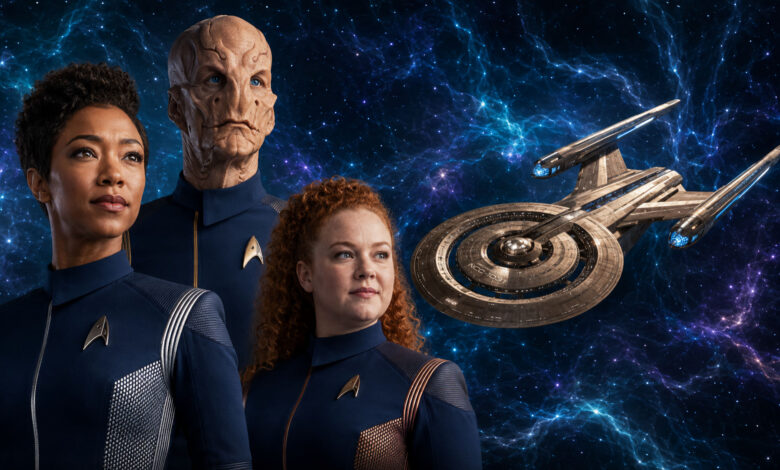
Star Trek: Discovery follows Michael Burnham, a human raised among Vulcans whose career takes a dramatic turn after a disastrous confrontation with the Klingons. Aboard the USS Discovery, she joins a crew developing technology that could transform space travel, while facing questions about loyalty, identity and the cost of survival.
This is a more serialised, emotionally expressive and action-heavy version of Star Trek. Season-long mysteries replace most standalone adventures, and personal relationships frequently carry as much weight as scientific discoveries.
It can overdo the urgency and sentiment, but its strongest moments find something worthwhile beneath the spectacle: people choosing connection when fear makes isolation seem easier.
🎬 Transmission Details
- Show title: Star Trek: Discovery
- Years: 2017–2024
- Created by: Bryan Fuller and Alex Kurtzman
- Network (US): CBS All Access, subsequently Paramount+; the premiere also aired on CBS
- Network (UK): Netflix initially; Season 4 initially aired through Pluto TV, with the series subsequently moving to Paramount+
- Seasons: 5
- Episodes: 65
- Starring: Sonequa Martin-Green, Doug Jones, Anthony Rapp, Mary Wiseman, Wilson Cruz, Shazad Latif, David Ajala and Blu del Barrio, with major roles across the series for Jason Isaacs, Michelle Yeoh, Anson Mount, Tig Notaro and Callum Keith Rennie.
Viewing note: Start with The Vulcan Hello and watch in release order. The opening two episodes establish Burnham’s situation before the Discovery itself becomes the main setting. Previous Star Trek knowledge adds context but isn’t essential. Selected Short Treks offer extra background, rather than being required viewing. The fifth season includes a concluding epilogue, so this is a completed story rather than an unresolved cancellation.
🎯 Signal Strength
- IMDb: 6.9/10
- Rotten Tomatoes: 84% critics / 34% audience — series averages
- Skully’s take: The ship runs on mushrooms, the galaxy rarely gets a quiet afternoon, and Starfleet’s counselling department presumably has a waiting list measured in light-years.
📼 Spoiler Mode: Story Sync for Pub Chat
Major spoilers ahead for all five seasons, including the series’ biggest revelations and its ending.
The story begins in the 23rd century, before Kirk’s command of the Enterprise. Michael Burnham serves under Captain Philippa Georgiou aboard the USS Shenzhou. Raised by Sarek and Amanda Grayson, she is Spock’s adoptive sister, combining a Vulcan education with emotions she cannot simply reason away.
During a confrontation with the Klingons, Burnham attempts to take command against Georgiou’s wishes. The encounter becomes a battle, Georgiou is killed, and Burnham is convicted of mutiny. Her attempt to avert catastrophe instead leaves her disgraced as war spreads between the Federation and the Klingons.
Captain Gabriel Lorca subsequently recruits her aboard Discovery, where scientist Paul Stamets is developing an experimental spore drive. By navigating a vast mycelial network, the ship can travel extraordinary distances almost instantaneously. The technology makes Discovery strategically invaluable, but Lorca’s willingness to exploit people and circumstances raises uncomfortable questions about its mission.
Those suspicions lead to a major revelation: Lorca comes from the Mirror Universe, where a ruthless version of Georgiou rules the Terran Empire. His apparent dedication to winning the war conceals an attempt to regain power in his own reality. Burnham helps defeat him and brings the alternate Georgiou back with her. When ending the Klingon war threatens to involve genocide, Burnham rejects that solution, insisting that survival cannot justify abandoning everything the Federation represents.
Season 2 brings Captain Christopher Pike aboard Discovery to investigate mysterious red signals and a figure known as the Red Angel. The mystery connects to Burnham’s mother, Gabrielle, and to Control, an artificial intelligence whose acquisition of ancient Sphere data threatens organic life. To keep that information beyond Control’s reach, Burnham and the Discovery crew travel more than nine centuries into the future.
They arrive in the 32nd century to find a fractured Federation and a galaxy traumatised by the Burn. This catastrophe rendered dilithium temporarily inert, destroying countless operating warp-powered ships and devastating interstellar connections. Burnham meets Cleveland “Book” Booker, a courier whose knowledge of this unfamiliar era helps her find a place in it.
The Burn’s cause proves painfully personal rather than a calculated attack. Su’Kal, a Kelpien whose development was affected by an unusual dilithium-rich environment, triggered the disaster through an extraordinary response to his mother’s death. Saru helps him confront that trauma, while Discovery’s crew overcomes the Emerald Chain’s attempt to seize their ship. Access to a substantial dilithium supply offers a route towards rebuilding, and Burnham finally becomes Discovery’s captain.
Season 4 tests that rebuilding effort through the Dark Matter Anomaly, which destroys Book’s homeworld and threatens other inhabited systems. His grief pushes him towards direct action, while Burnham pursues contact with the beings responsible. Species 10-C are conducting mining operations without understanding the lives they are destroying. Communication, rather than military victory, becomes the decisive breakthrough, persuading them to stop.
The final season follows a search for technology once used by the Progenitors to shape humanoid life. Burnham’s crew competes with fugitives Moll and L’ak, with the Breen drawn into the pursuit. Reaching the technology forces Burnham to decide whether anyone should control such power. She chooses to relinquish it, sending its gateway into a black hole rather than handing it to the Federation or its enemies.
The closing revelations include Kovich identifying himself as Agent Daniels, linking the story back to Enterprise. Saru marries T’Rina, and a later epilogue finds Burnham an admiral, sharing a life with Book and their adult son. She takes Discovery on a final classified assignment, leaving the ship and its sentient intelligence, Zora, to await a future encounter connected to Short Treks: Calypso.
For a series so often concerned with imminent extinction, its final emphasis is more intimate: the meaning people find in their relationships and the lives they choose to build.
🧠 Vibe Check
- 🌌 Cinematic space adventure built around season-long mysteries and escalating threats
- 💫 Experimental technology, strange environments and dramatic changes of setting
- 👥 Found-family relationships, emotional recovery and questions of belonging
- ⚖️ Federation ideals tested by war, fear, grief and the temptation to take shortcuts
Perfect if you like: Star Trek: Deep Space Nine for serialised challenges to Federation principles, Battlestar Galactica for pressured crews and emotionally charged decisions, or Star Trek: Picard for character-led stories with large-scale consequences.
🚀 Why It’s a Sci-Fi Icon
- 📺 It brought Star Trek back to television: Arriving in 2017, twelve years after Enterprise ended, Discovery opened a new chapter for the franchise on the small screen. Its storytelling choices remain divisive, but its importance to that revival is clear. It demonstrated that new Star Trek television could take a substantially different form.
- 🧑🚀 It began with someone outside the captain’s chair: Burnham’s introduction as a disgraced officer gives the series a different perspective on Starfleet. Rather than starting with an established leader whose judgement everyone trusts, it follows someone rebuilding her identity and professional standing. That approach creates room for uncertainty, mistakes and an unusually personal relationship with authority.
- 🤝 It made belonging central to its relationships: Stamets and Culber’s partnership, alongside Adira and Gray’s stories, broadens the range of lives represented aboard a Starfleet ship. The most effective scenes treat care as something practical: helping someone recover, listening when they struggle, or making space for a person whose experience differs from your own.
- 🔭 It was willing to change its own premise: Few franchise series transform their circumstances as dramatically as Discovery. That willingness creates fresh possibilities, even when the transitions are uneven. At its best, the show uses unfamiliar conditions to ask what remains essential about Starfleet when established institutions and assumptions can no longer be relied upon.
- 🖖 Its best resolutions still depend on understanding: Despite its emphasis on battles and spectacular danger, Discovery repeatedly returns to a recognisably Trek-like argument: another being’s motives may be incomprehensible without being malicious. The strongest examples make communication demanding rather than automatic, requiring patience, humility and a willingness to reconsider the apparent nature of the threat.
- 🛸 It helped launch Strange New Worlds: Season 2’s Pike, Spock and Number One offered another way to explore this era, leading into a series with a more episodic approach. That contrast is useful: Discovery didn’t simply revive familiar characters, but helped create space for different styles of Star Trek to coexist.
🔦 Deep Dive Highlights
- 🌠 Michael Burnham: Sonequa Martin-Green gives Burnham intensity, vulnerability and an often uncomfortable determination to act. Her Vulcan upbringing doesn’t eliminate emotion; it complicates how she understands and expresses it. The character works best when the series allows her to learn from other people, rather than making every solution depend on her alone.
- 👽 Saru: Doug Jones creates a remarkably expressive character beneath extensive alien makeup. Saru’s caution is initially easy to mistake for timidity, but his thoughtfulness becomes a source of authority. His development gives the series one of its most satisfying through-lines, exploring the difference between recognising danger and allowing fear to govern every decision.
- 🧬 Paul Stamets and Hugh Culber: Anthony Rapp and Wilson Cruz provide a relationship grounded in both affection and difficulty. Stamets’ scientific intensity and Culber’s care for others don’t exempt them from hurt or misunderstanding. Together, they give the ship a domestic dimension that survives beyond the latest emergency and becomes important to other crew members.
- ✨ Sylvia Tilly: Mary Wiseman’s Tilly brings enthusiasm, nervous energy and an openness that contrasts with Burnham’s guarded manner. Her strongest quality isn’t that she never doubts herself, but that she keeps finding ways to contribute. The friendship between the two women helps establish Discovery as a community rather than merely a highly classified workplace.
- 🐈 Cleveland “Book” Booker: David Ajala introduces a different perspective on the galaxy, shaped by independence, empathy and responsibilities beyond Starfleet. Book’s relationship with Burnham creates warmth without removing their disagreements. He also travels with Grudge, a cat whose commanding presence suggests that formal rank is not the only route to authority aboard a spacecraft.
- 🍄 USS Discovery and the Spore Drive: The ship’s unusual propulsion system gives it a distinctive place in the franchise, opening possibilities beyond conventional warp travel. It also creates questions about the living network being used and the people required to navigate it. The science is firmly speculative, but the ethical implications make useful storytelling material.
Star Trek: Discovery is ambitious, uneven and rarely understated. Its constant escalation can crowd out quieter exploration, and some supporting officers deserve more attention than they receive. But its strongest relationships and most thoughtful encounters make a persuasive case for its central belief: connection is not a distraction from the mission. Sometimes, it is the mission.
Recommended Sci-Fi TV Products
Watch The Walking Dead on Prime Video
County Sheriff Rick Grimes, his wife, son and a small eclectic group try to survive constant attacks from zombies and other threats.
Watch Now!
Watch The X-Files on Prime Video
A young FBI agent is assigned watchdog duty over a fellow agent, but finds herself drawn into his investigations of paranormal and unexplained phenomena.
Watch Now!
Watch Fallout on Prime Video
Based on one of the greatest video games of all time, Fallout is the story of haves and have-nots in a world in which there’s almost nothing left to have.
Watch Now!As an Amazon Associate I earn from qualifying purchases.