✨ Byte-Sized Overview
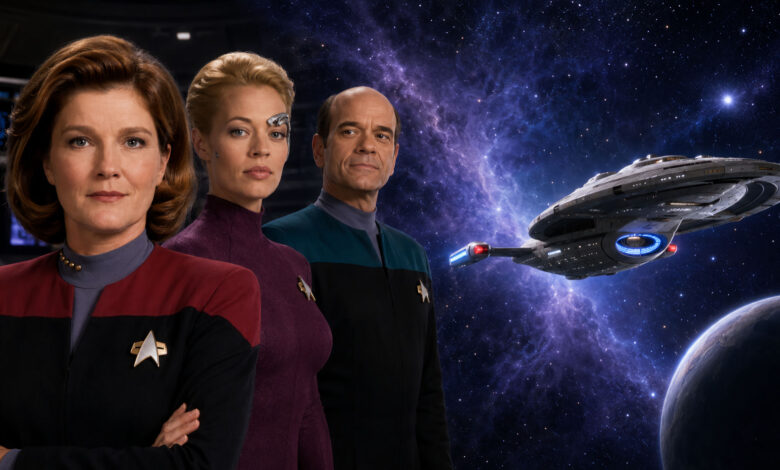
A new starship, a routine mission and a journey home that could take most of a lifetime. Star Trek: Voyager sends Captain Kathryn Janeway and her crew roughly 70,000 light-years from familiar territory, then asks them to remain explorers when survival might seem a more sensible priority.
Stranded in the Delta Quadrant, Voyager has no nearby starbases, no reliable supply line and no admiral ready to resolve a difficult decision. Its crew must negotiate with unfamiliar civilisations, investigate extraordinary phenomena and decide how much of their identity they are willing to compromise to get home.
The result combines classic Star Trek adventure with a strong sense of displacement and found family. Some episodes offer scientific puzzles or playful holodeck diversions; others explore assimilation, artificial intelligence and the responsibilities of command.
It does not always exploit its survival premise as consistently as it could, but its strongest stories deliver imagination, moral complexity and genuine warmth. Somewhere along the way, a ship full of people trying to reach home begins to feel like home itself.
🎬 Transmission Details
- Show title: Star Trek: Voyager
- Years: 1995–2001
- Created by: Rick Berman, Michael Piller and Jeri Taylor
- Network (US): UPN
- Network (UK): Sky One; later BBC Two
- Seasons: 7
- Episodes: 172
- Starring: Kate Mulgrew, Robert Beltran, Roxann Dawson, Robert Duncan McNeill, Tim Russ, Garrett Wang, Robert Picardo, Ethan Phillips, Jennifer Lien and Jeri Ryan
The standard 172-episode total counts feature-length stories as their individual television parts, so some platform listings show fewer separate entries.
Begin with Caretaker and follow the seasons in order. Familiarity with earlier Star Trek adds context, particularly around Starfleet and the Borg, but the central situation is straightforward enough for newcomers. The series completes its seven-season story rather than ending through cancellation.
🎯 Signal Strength
- IMDb: 7.9/10
- Rotten Tomatoes: 77% critics / 81% audience — series averages
- Skully’s take: Seventy thousand light-years from home, no backup, and the captain is still expected to function before coffee.
📼 Spoiler Mode: Story Sync for Pub Chat
Major spoilers ahead for the series, including the ending.
Voyager’s first mission takes it into the Badlands to locate a missing Maquis vessel. The Maquis are resistance fighters opposed to Federation policy along the Cardassian border, making them unlikely candidates for a comfortable partnership with Starfleet. Before that conflict can be resolved, an alien entity known as the Caretaker pulls both ships into the distant Delta Quadrant.
The Caretaker has been searching for a successor capable of protecting the Ocampa, a people dependent on his technology. When he dies, Janeway faces a choice between preserving the array that could send her people home and preventing its capture by the aggressive Kazon. She destroys it to protect the Ocampa, committing everyone to a journey initially estimated at around 75 years.
After the Maquis ship is lost, its survivors join Voyager. Their leader, Chakotay, becomes Janeway’s first officer, while B’Elanna Torres takes charge of engineering. Tuvok, who had been working undercover among the Maquis, resumes his Starfleet duties. The combined crew must turn political opponents into colleagues, with Janeway insisting that distance from the Federation does not make its principles optional.
Two local travellers, Neelix and Kes, also join them. Neelix supplies regional knowledge and considerable enthusiasm; Kes becomes an important presence in sickbay. With the ship’s original medical staff dead, the Emergency Medical Hologram must remain active far beyond his intended emergency role. The Doctor gradually develops interests, relationships and an increasingly forceful claim to be treated as a person.
Early dangers include the competing Kazon factions and the Vidiians, whose desperate struggle against disease has led them to harvest organs from other species. Yet the voyage changes most significantly when the crew enters Borg territory.
In Scorpion, Janeway forms a precarious alliance with the Collective against Species 8472, an enemy powerful enough to threaten the Borg themselves. The agreement brings the drone Seven of Nine aboard Voyager. When the alliance collapses, Seven is severed from the Collective and remains with the crew. Formerly a human child named Annika Hansen, she must confront individuality after spending much of her life without it.
Her recovery is neither immediate nor comfortable. Janeway sees someone who can reclaim a life; Seven initially sees isolation from the only existence she understands. Around the same time, Kes’s expanding mental abilities make remaining aboard dangerous. She leaves Voyager and propels the ship thousands of light-years closer to home.
The journey repeatedly tests Janeway’s claim that survival cannot justify everything. In Equinox, Voyager encounters another stranded Starfleet ship whose captain has been killing alien lifeforms to accelerate his return. Janeway’s determination to stop him becomes dangerously obsessive, exposing how easily righteous conviction can slide towards the very ruthlessness it condemns.
Meanwhile, the crew begins rebuilding its connection with the Federation. The Doctor’s mission in Message in a Bottle lets Starfleet know Voyager has survived. Later, Reginald Barclay’s work on Project Pathfinder establishes two-way communication, turning home from a distant memory into a place actively trying to reach them.
In the finale, Endgame, an older Admiral Janeway travels back from a future in which Voyager’s return took 23 years and came at a painful personal cost. She offers her younger self advanced technology and a shortcut through Borg transwarp infrastructure.
Captain Janeway refuses to consider only her own crew’s escape when the same opportunity could strike a major blow against the Borg. Together, the two Janeways devise a plan to achieve both. The admiral sacrifices herself, infecting the Collective with a pathogen, while Voyager escapes through a collapsing transwarp corridor and emerges near Earth.
The ship finally reaches home after seven years. B’Elanna gives birth to her daughter with Tom Paris, adding a new beginning to the end of the journey. The finale resolves the central question decisively, although it leaves the crew’s reunions and adjustment to life back in the Federation largely to the imagination.
🧠 Vibe Check
- 🚀 Exploration and survival aboard a lone ship far beyond familiar territory
- 🧭 Command decisions that pit the quickest route home against ethical responsibility
- 🤖 Questions of individuality, artificial life and recovery from assimilation
- 🏠 Found-family warmth, friendships and everyday routines between interstellar emergencies
Perfect if you like: Star Trek: The Next Generation for thoughtful space adventures, Stargate Atlantis for a team operating far from home, or Farscape for the bond between travellers brought together by extraordinary circumstances.
Despite its continuing journey, Voyager is mostly episodic rather than a tightly serialised survival drama. Many stories introduce and resolve their central problem within one episode, while relationships and larger threats develop across the seasons.
That structure makes it approachable, but it also creates an occasional mismatch between premise and execution. Resources, damage and internal disagreements do not always accumulate as convincingly as the situation suggests they should. Think of it primarily as an exploration series with a powerful emotional destination, rather than seven seasons of steadily worsening deprivation.
🚀 Why It’s a Sci-Fi Icon
- 👩✈️ It put a female captain at the centre of a Star Trek series: Janeway was not the franchise’s first woman to command a starship, but she was the first to lead one of its television series. Kate Mulgrew gives her scientific curiosity, formidable authority and a capacity for warmth that never makes command look effortless.
- 🧭 It tests ideals without their usual support system: Starfleet principles are easier to defend when help is nearby. Voyager removes that reassurance. Its best dilemmas ask whether a value remains meaningful when maintaining it creates real danger, and whether reaching home would still count as success if the crew abandoned everything it represented.
- 🧠 Seven of Nine gives the Borg story a personal dimension: The Collective is not merely a fleet of threatening cubes. Through Seven, assimilation becomes something that has happened to a person who must build a life afterwards. Jeri Ryan makes her precision, defensiveness, curiosity and awkward humour parts of an evolving character rather than a single alien mannerism.
- 🩺 The Doctor develops far beyond his original function: Robert Picardo’s holographic physician begins as an emergency tool with a difficult bedside manner. His growing emotional life creates stories about autonomy, dignity and recognition. The question is not simply whether he behaves like a person, but whether others will accept obligations towards him when that becomes inconvenient.
- 🌌 Its format makes room for bold standalone ideas: Without remaining tied to one region, Voyager can encounter radically different societies and phenomena. Episodes such as Living Witness, Latent Image and Year of Hell demonstrate its range, moving between historical interpretation, personal responsibility and large-scale peril without losing the familiar crew at their centre.
- 🤝 It understands the emotional value of belonging: The destination supplies the obvious motivation, but relationships make the journey worth following. Shared meals, professional trust, romances and small acts of kindness gradually matter as much as navigational progress. The ship becomes a community, not simply a vehicle transporting people back to their previous lives.
🔦 Deep Dive Highlights
- ☕ Captain Kathryn Janeway: Scientist, commander and the person who must live with the consequences of decisions nobody else can make. Mulgrew is especially effective when Janeway’s certainty meets a problem that cannot be solved through determination alone. Her generosity and stubbornness often come from the same fiercely protective instinct.
- 🔗 Seven of Nine: A character whose directness can be funny, abrasive or quietly heartbreaking depending on the situation. Her scenes with Janeway and the Doctor are particularly rewarding because all three have different ideas about what helping her should involve. Progress means gaining choices, not simply learning to imitate everyone around her.
- 🎭 The Doctor: Medical competence is only the beginning. Picardo brings comic timing and vulnerability to a character who can be pompous, compassionate, insecure and genuinely brave. Stories focused on his memories and independence are among the show’s strongest, because they make an abstract debate about artificial life feel immediate and personal.
- ⚙️ The Starfleet–Maquis Crew: Chakotay and B’Elanna embody different responses to being folded into Janeway’s command. Chakotay must represent his people while helping keep the ship united; B’Elanna’s engineering brilliance comes with frustration and a complicated relationship with authority. The series sometimes settles their political differences too quickly, but the underlying tension gives the premise useful weight.
- 🛸 The Delta Quadrant: Voyager’s unfamiliar surroundings allow new societies to define the challenges rather than relying entirely on established Federation rivals. The Kazon, Vidiians and Hirogen present very different threats, while encounters with the Borg give the journey an imposing larger danger. Exploration here can require diplomacy, improvisation or a rapid retreat.
- 🏡 Life Aboard Voyager: Tom Paris and Harry Kim’s friendship, Tuvok’s dry restraint, Neelix’s attempts to maintain morale and the crew’s holodeck escapes provide necessary texture between crises. These scenes remind us what everyone is trying to preserve: not merely a functioning warp drive, but a recognisable life with companionship, interests and moments of ordinary happiness.
Star Trek: Voyager is at its best when the desire to get home strengthens its curiosity rather than replacing it. There are uneven episodes and missed opportunities, but also memorable characters, inventive dilemmas and a reassuring belief that people can build something worthwhile in circumstances they never chose. The destination gives the series direction; the crew gives it a reason to keep watching.
Recommended Sci-Fi TV Products
Watch The Expanse on Prime Video
Amidst political tension between Earth, Mars and the Belt, the single greatest conspiracy of all time must be unravelled.
Watch Now!
Watch Fallout on Prime Video
Based on one of the greatest video games of all time, Fallout is the story of haves and have-nots in a world in which there’s almost nothing left to have.
Watch Now!
Watch The X-Files on Prime Video
A young FBI agent is assigned watchdog duty over a fellow agent, but finds herself drawn into his investigations of paranormal and unexplained phenomena.
Watch Now!As an Amazon Associate I earn from qualifying purchases.