✨ Byte-Sized Overview
Before Kirk delivered his first dramatic pause and Picard perfected the diplomatic dressing-down, Jonathan Archer took humanity into deep space with an experimental ship, an enthusiastic crew and a beagle.
Star Trek: Enterprise explores the franchise’s pioneering years, when Earth is still finding its place among older, more experienced civilisations. There’s no Federation to fall back on, the technology has limitations, and first contact frequently involves discovering that somebody else finds your perfectly reasonable behaviour deeply offensive.
It starts as an adventure about exploration, becomes a desperate mission to protect Earth, and eventually turns towards the difficult business of building alliances.
The journey is uneven, but its best episodes make the familiar Star Trek future feel like something people had to earn.
🎬 Transmission Details
- Show title: Star Trek: Enterprise, originally titled Enterprise
- Years: 2001–2005
- Created by: Rick Berman and Brannon Braga
- Network (US): UPN
- Network (UK): Sky One; subsequently Channel 4
- Seasons: 4
- Episodes: 98, counting the feature-length premiere as two episodes
- Starring: Scott Bakula, Jolene Blalock, Connor Trinneer, Dominic Keating, Linda Park, Anthony Montgomery and John Billingsley. Notable recurring performers include Jeffrey Combs, Gary Graham, Vaughn Armstrong and Matt Winston.
Viewing note: Begin with Broken Bow and watch in broadcast order. The early seasons are largely episodic, Season 3 follows a sustained storyline, and Season 4 favours shorter linked adventures. Although cancelled after four seasons, the show does receive an ending. Its final episode is best approached as a franchise epilogue; the preceding two-parter, Demons and Terra Prime, provides the stronger conclusion to the crew’s immediate story.
🎯 Signal Strength
- IMDb: 7.6/10
- Rotten Tomatoes: 56% critics / 79% audience — series averages
- Skully’s take: Humanity’s first proper interstellar road trip: experimental engines, awkward introductions and a captain who brought his dog. The Vulcans would like it formally recorded that they advised against all of this.
📼 Spoiler Mode: Story Sync for Pub Chat
Major spoilers ahead, including the Xindi storyline, important character developments and the series finale.
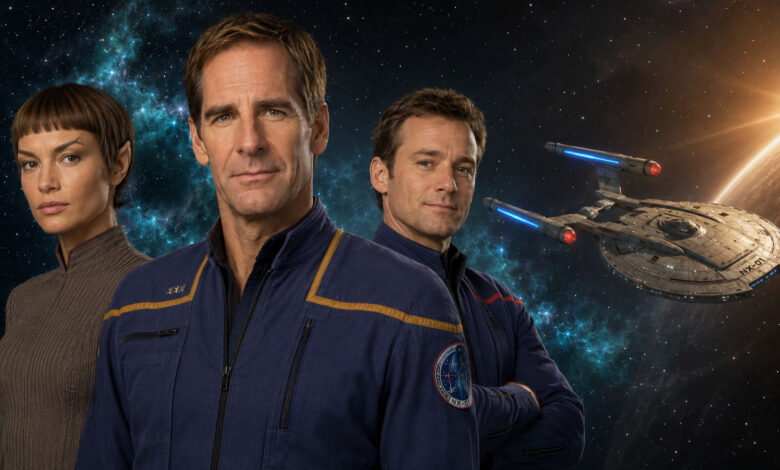
The story begins in 2151, when an injured Klingon’s arrival on Earth gives Captain Jonathan Archer the opportunity to launch Enterprise NX-01 ahead of its planned schedule. The ship’s warp-five engine promises to carry humans further and faster than before. Archer sees it as the fulfilment of his father’s work and a chance to escape what he regards as years of unnecessary Vulcan supervision.
His crew includes chief engineer Trip Tucker, armoury officer Malcolm Reed, communications specialist Hoshi Sato, helmsman Travis Mayweather and the Denobulan physician Phlox. Vulcan officer T’Pol joins as an experienced adviser, but her caution repeatedly clashes with Archer’s eagerness. Their developing trust becomes central to the series.
The early missions reveal that interstellar politics are considerably messier than Earth’s optimistic explorers expected. In The Andorian Incident, Archer discovers that a supposedly peaceful Vulcan monastery conceals a surveillance installation. Revealing the truth damages his relationship with the Vulcans but earns the respect of Andorian commander Shran. It establishes an important principle: friendship cannot simply mean endorsing an ally’s dishonesty.
Meanwhile, the crew becomes entangled in the Temporal Cold War, a conflict involving factions manipulating history. The Suliban and temporal agent Daniels draw Archer into events whose full significance he cannot yet understand. His small ship, it turns out, occupies a particularly important place in the future.
The series changes sharply when a Xindi weapon attacks Earth, killing millions, including Trip’s sister. Enterprise enters the dangerous Delphic Expanse to prevent a second weapon from destroying the planet. Exploration becomes a mission of survival, with military personnel aboard and Archer increasingly willing to cross lines he would previously have condemned.
Crucially, the Xindi aren’t a single, unified enemy. Their different species have competing interests, and they have been manipulated into believing humanity threatens their future. Archer gradually builds trust with the weapons designer Degra and other potential allies. Saving Earth requires both stopping the weapon and persuading some of its creators that they have been deceived.
The mission leaves lasting damage. Enterprise takes a severe battering, crew members die, and Archer steals equipment from another vessel because he believes the alternative is failure. Trip struggles with grief, while his relationship with T’Pol develops into an emotionally complicated romance. The eventual victory protects Earth without restoring everyone to the people they were before the attack.
After resolving the Temporal Cold War storyline, Season 4 turns towards the foundations of the Federation. Vulcan political and spiritual upheaval challenges the attitudes that have shaped Earth’s relationship with its closest alien neighbour. Romulan interference also pushes humans, Vulcans, Andorians and Tellarites towards cooperation against a shared threat.
The most painful challenge comes from humanity itself. In Demons and Terra Prime, an isolationist movement tries to drive aliens out of Earth’s solar system. Its leaders create a child using stolen genetic material from Trip and T’Pol, intending to exploit fear of interspecies relationships. The baby, Elizabeth, dies because of flaws in the cloning process. Trip and T’Pol’s grief gives the political story an intimate, devastating cost.
The final episode, These Are the Voyages…, jumps to 2161, with Archer preparing for the Federation’s founding ceremony. These events are presented through a historical holodeck recreation watched by Riker and Troi during The Next Generation. Trip sacrifices himself to save Archer, and the captain prepares to honour everything their journey has achieved.
It’s an awkward farewell because the framing distances us from Enterprise’s own crew. Terra Prime offers the more persuasive final statement: a better future is possible, but prejudice and fear do not disappear simply because humanity reaches the stars.
🧠 Vibe Check
- 🚀 Pioneering space exploration with practical uniforms and equipment that doesn’t solve everything
- 🖖 Cultural misunderstandings, uneasy diplomacy and alliances built through personal trust
- ⚔️ A darker middle stretch involving survival, grief and compromised principles
- 👥 Close shipboard friendships, dry Vulcan observations and a welcome lack of captainly perfection
Perfect if you like: Star Trek: The Original Series for its exploratory spirit, Stargate SG-1 for humans negotiating an unfamiliar galactic neighbourhood, or Star Trek: Voyager for a small crew facing problems without convenient backup.
🚀 Why It’s a Sci-Fi Icon
- 🛠️ It made the future feel unfinished: Enterprise’s crew cannot rely on the accumulated experience available to Picard or Janeway. Procedures are still developing, equipment has obvious limitations, and unfamiliar situations genuinely feel unfamiliar. That roughness gives the setting its appeal: these people are helping write the instructions that later generations will take for granted.
- 🌍 It treated cooperation as an achievement: The Federation’s existence can make its founding relationships seem inevitable. Enterprise restores the suspicion, rivalry and bruised pride beneath them. Its strongest diplomatic stories show why former enemies might choose to work together without suggesting that one inspiring speech instantly makes centuries of distrust disappear.
- ⚖️ It challenged its captain’s confidence: Archer’s enthusiasm is often attractive, but eagerness and good intentions aren’t enough. He can be impatient, defensive and dangerously certain of himself. The series becomes more interesting when it lets those qualities have consequences, particularly when protecting his own people conflicts with treating others fairly.
- 📚 It experimented with different storytelling structures: The move from largely standalone adventures to Season 3’s continuing mission gives the show greater urgency. Season 4 then finds a useful middle ground through compact multi-part stories. Those approaches produce a series whose later identity feels quite different from its comparatively relaxed opening stretch.
- 👽 It gave familiar alien cultures room to grow: The Andorians become much more than blue faces and antennae, while Vulcan society receives scrutiny beyond its reputation for logic. Characters such as Shran and Soval make political relationships personal. Their pride, loyalties and changing judgements give the prequel setting more substance than a catalogue of recognisable names.
- 🔍 Its best stories stand beyond the prequel premise: Shuttlepod One, Carbon Creek, Similitude and Observer Effect offer different combinations of character drama, mystery and ethical tension. You don’t need to spend every episode checking continuity. The strongest reason to watch is simpler: this crew has worthwhile stories of its own.
🔦 Deep Dive Highlights
- 🧑🚀 Captain Jonathan Archer: Scott Bakula brings approachable warmth to a captain who is still learning what leadership demands beyond enthusiasm and technical ability. Archer’s strongest moments come when confidence gives way to reflection. He wants to prove humanity belongs among the stars, but must also learn that other civilisations aren’t obliged to share his assumptions.
- 🖖 T’Pol: Initially positioned as the cautious outsider, T’Pol becomes essential to the Enterprise community. Jolene Blalock’s restrained performance makes small shifts in expression carry considerable weight. Her story is most engaging when it explores loyalty, cultural expectations and personal choice, allowing her to become more than the person explaining why the humans are being reckless.
- 🔧 Charles “Trip” Tucker III: The chief engineer supplies much of the show’s warmth, humour and emotional immediacy. Connor Trinneer makes his technical confidence and personal vulnerability equally convincing. Trip can repair an engine under appalling conditions, but understanding another person, or coping with loss, proves considerably less straightforward than diagnosing a mechanical fault.
- 🩺 Doctor Phlox: John Billingsley’s cheerful Denobulan physician regards human behaviour with affectionate curiosity rather than automatic agreement. His unconventional medical approach helps make the ship feel like a meeting point between cultures. Beneath the genial manner is someone perfectly capable of asking difficult questions about consent, responsibility and the limits of medical intervention.
- 👽 Commander Shran: Jeffrey Combs gives the Andorian commander a marvellous combination of suspicion, pride and reluctant affection. Shran can turn an apparently straightforward conversation into a diplomatic incident, yet his sense of obligation makes him more than an unpredictable adversary. His exchanges with Archer are among the show’s liveliest encounters.
- 🛰️ Enterprise NX-01 and Its Crew: This Enterprise feels closer to a working vessel than a floating conference centre. Hoshi’s language skills, Reed’s preparedness and Mayweather’s piloting experience should all be essential to its success. The series doesn’t always give them enough attention, but their presence reinforces the idea that exploration depends on different kinds of expertise.
Star Trek: Enterprise doesn’t always fulfil the promise of its setting, and its final episode remains a frustrating choice. But there is far more here than an awkward theme tune debate and a premature cancellation. At its best, it makes the Federation’s ideals feel hard-won, while giving us a crew worth accompanying through the difficult early miles.
Recommended Sci-Fi TV Products
Watch Fallout on Prime Video
Based on one of the greatest video games of all time, Fallout is the story of haves and have-nots in a world in which there’s almost nothing left to have.
Watch Now!
Watch The Walking Dead on Prime Video
County Sheriff Rick Grimes, his wife, son and a small eclectic group try to survive constant attacks from zombies and other threats.
Watch Now!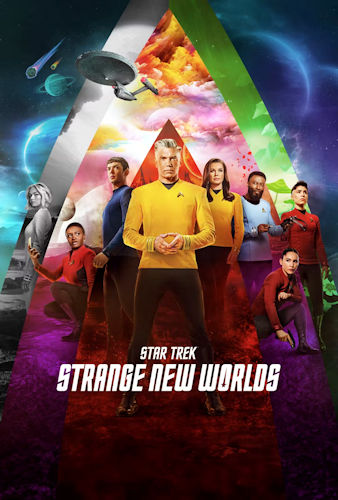
Watch Star Trek: Strange New Worlds on Prime Video
STAR TREK: STRANGE NEW WORLDS is based on the years Captain Christopher Pike manned the helm of the U.S.S. Enterprise. The series will follow Captain Pike, Officer Spock and Number One in the years before Captain Kirk boarded the U.S.S. Enterprise.
Watch Now!As an Amazon Associate I earn from qualifying purchases.