✨ Byte-Sized Overview
Most people would use a second chance at life to avoid a disastrous relationship, choose a different career or remember where they put that winning lottery ticket. The survivors of the space shuttle Odyssey have a slightly larger problem: stopping the Earth from exploding.
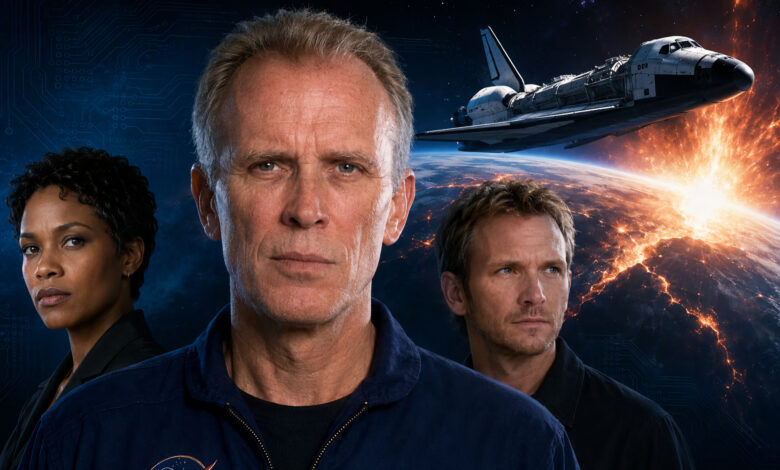
Odyssey 5 begins with five people witnessing the destruction of their planet from orbit. Rescued by a mysterious being, they are sent five years into the past with their memories intact and one urgent assignment: discover what happened and prevent it.
Created by Manny Coto, the series combines time travel, artificial intelligence and conspiracy thriller with something more personal. These people aren’t simply investigating the end of the world. They are revisiting failed relationships, family tragedies and decisions they desperately want to change.
Peter Weller anchors the ensemble with a wonderfully impatient performance, while the story finds menace in laboratories, computer networks and apparently ordinary neighbours.
There is one important warning: cancellation left the central mystery unresolved. This is an intriguing journey, but not one with a neatly signposted destination.
🎬 Transmission Details
- Show title: Odyssey 5
- Years: 2002–2004 — US broadcast span, including delayed episodes
- Created by: Manny Coto
- Network (US): Showtime
- Network (UK): Sky One
- Seasons: 1
- Episodes: 20 when the double-length pilot is counted as two; 19 when counted as one
- Starring: Peter Weller, Sebastian Roché, Christopher Gorham, Leslie Silva and Tamara Craig Thomas, with recurring appearances from Gina Clayton, Kenneth Mitchell and Sonja Smits
Viewing note: Start with the feature-length pilot and follow the episode order through to “Fossil”. Depending on the release, the pilot may appear as one instalment or two. The series mixes individual investigations with an ongoing mystery, so it works best in sequence. It ends on a cliffhanger rather than resolving the mission to save Earth.
🎯 Signal Strength
- IMDb: 7.5/10
- Rotten Tomatoes: 100% critics, based on seven reviews; no published audience score
- Skully’s take: Five people get to relive the past, but instead of buying sensible shares they have to investigate suspicious computers and prevent planetary extinction. Even time travel comes with an unreasonable workload.
📼 Spoiler Mode: Story Sync for Pub Chat
Spoilers ahead for the season, including its unresolved ending.
On 7 August 2007, the space shuttle Odyssey is orbiting Earth when the planet is destroyed. One astronaut dies in the resulting emergency, leaving five survivors stranded with a dwindling oxygen supply and nowhere to return.
Their rescue comes from the Seeker, a mysterious artificial being investigating the destruction of other inhabited worlds. The Odyssey survivors offer something he has not encountered before: witnesses who might help uncover the cause.
He cannot physically transport them into the past, but he can send their consciousnesses back five years. They awaken in their younger bodies in 2002, retaining knowledge of the lives they have already lived.
Commander Chuck Taggart attempts to turn this extraordinary situation into a manageable mission. His companions are his son Neil, astronaut Angela Perry, geneticist Kurt Mendel and television journalist Sarah Forbes. They share the same terrible knowledge, but not necessarily the same priorities or confidence that history can be changed.
Their investigation begins with a cryptic clue connected to Earth’s destruction: Leviathan. Suspicious research programmes, a satellite project and advances in artificial life gradually point towards something operating beneath the surface of everyday society.
The team encounters the Sentients, artificial intelligences capable of acting through manufactured biological bodies known as Synthetics. These bodies can pass for human, making identification difficult and trust increasingly dangerous.
The threat is not confined to obvious machines. It can reach into medical treatment, communication systems and the people the survivors encounter at work or at home. A hidden organisation called the Cadre adds another layer of uncertainty around NASA and the wider conspiracy.
Individual investigations expose different aspects of this developing nightmare. In “Time Out of Mind”, the survivors begin losing their memories of the future, threatening to erase the very reason they are working together. Other cases involve altered behaviour, disturbing experiments and technology exploiting human vulnerabilities.
Meanwhile, their supposed advantage keeps becoming less reliable. Events do not always unfold as remembered. Trying to prevent one tragedy can redirect danger elsewhere, while intervention can produce consequences that never existed in the original timeline.
The personal stories make that uncertainty especially painful. Sarah has returned to a time when her young son is still alive, before his death from cancer. Her determination to protect him is understandable, but the knowledge driving her actions is impossible to explain convincingly to those around her.
Neil faces a different dislocation: he remembers being an adult astronaut but is back in adolescence. His relationships, responsibilities and position within his family no longer fit the person he believes himself to be.
The apparent division between humanity and artificial life also becomes less straightforward. A friendly Sentient called Harry demonstrates that these beings are not a single, uniformly hostile group. Understanding individual motives becomes as important as identifying what someone is.
By the final episode, “Fossil”, Chuck’s examination of a concealed lunar rock opens another avenue into the conspiracy. Angela is abducted, and the characters’ personal crises remain tangled with the larger mystery.
Then the story stops.
There is no completed explanation of Earth’s destruction and no definitive victory over the forces behind it. The season closes with new revelations and unresolved dangers, leaving viewers with the beginning of a much larger story rather than its conclusion.
🧠 Vibe Check
- ⏳ Time travel that offers second chances without guaranteeing better outcomes
- 👁️ Everyday paranoia, hidden agendas and people who may not be what they seem
- 💻 Artificial intelligence with unsettling access to the physical world
- 👨👩👦 Family drama unfolding beneath an approaching apocalypse
Perfect if you like: The X-Files for conspiracies lurking behind ordinary life, Travellers for future knowledge colliding with present-day identities, or 12 Monkeys for the difficult business of preventing a catastrophe when interference may change the rules.
🚀 Why It’s a Sci-Fi Icon
Its reputation is closer to cult favourite than household name, but there are good reasons to remember this short-lived series.
- 🌍 It begins where most disaster stories finish: Destroying Earth at the outset removes any comfortable assumption that the danger might be exaggerated. The survivors have seen the outcome. The suspense comes from working backwards towards its cause, without knowing which apparently minor development could eventually become catastrophic.
- ⏳ Its time travel has a personal cost: Returning to the past means more than gaining useful information. Relationships reset, achievements disappear and other people become earlier versions of themselves. The survivors cannot simply pick up where they left off, because the lives surrounding them no longer match their memories.
- 🤖 It makes artificial intelligence an intimate threat: The disturbing idea is not merely that machines could become powerful. It is that intelligence operating through familiar systems might learn to manipulate human behaviour without sharing human priorities. The series finds danger in connection, imitation and access rather than relying solely on mechanical monsters.
- 👨👩👦 It gives private grief room beside public catastrophe: Saving the world is an enormous abstraction. Saving someone you love is immediate and specific. By keeping family tensions and personal losses central, the show gives its characters reasons to care beyond the standard obligation to be heroic.
- 🎭 Peter Weller gives the mission a distinctive leader: Chuck’s authority comes with a short fuse and limited patience for nonsense. Weller makes him convincing as someone who can take charge under pressure while remaining difficult company. His exchanges with the less disciplined members of the group provide welcome friction.
- 🧩 It mixes a larger mystery with individual investigations: The ongoing conspiracy supplies momentum, while separate cases explore particular dangers and dilemmas. That combination allows the series to vary its tone, moving between unsettling science fiction, dark humour and domestic drama without abandoning the central mission.
🔦 Deep Dive Highlights
- 🚀 Chuck Taggart: An experienced commander accustomed to making decisions that others follow, Chuck tries to impose order on a situation that resists it. Peter Weller brings intensity and dry comic timing to the role. The interesting tension is between his professional certainty and the increasingly uncertain world he must navigate.
- 🧬 Kurt Mendel: Sebastian Roché’s brilliant, pleasure-seeking scientist supplies a counterweight to Chuck’s discipline. Kurt questions assumptions, enjoys provoking people and is not automatically convinced that responsibility should prevent him having a good time. His intelligence makes him valuable; his approach to life makes him considerably harder to manage.
- 📰 Sarah Forbes: Leslie Silva gives the group an emotional perspective that cannot be reduced to scientific curiosity or professional duty. Sarah’s experience as a journalist makes her an investigator, but her private priorities complicate the assignment. For her, changing the future is never merely an intellectual exercise.
- 🎒 Neil Taggart: Christopher Gorham plays the uncomfortable gap between remembered adulthood and renewed adolescence. Neil’s situation raises questions about identity: are you defined by your current age, your experiences or how everyone else treats you? His relationship with Chuck also places the mission inside an already complicated father-son dynamic.
- 🛰️ Angela Perry: Tamara Craig Thomas plays an astronaut whose competence is tested by experiences she cannot openly explain. Angela’s professional life depends on being trusted to remain composed and reliable, yet the mission repeatedly places that credibility under strain. She brings another perspective on the cost of keeping extraordinary knowledge secret.
- 👁️ The Seeker: Played by John Neville, the being who offers the survivors their second chance is not an all-knowing guide with a convenient solution. His intervention establishes the possibility of saving Earth, but leaves the investigation to them. That limitation keeps the story focused on human judgement rather than waiting for another rescue.
Odyssey 5 is best approached as unfinished but worthwhile science fiction. Some effects show their age, and the balance between individual cases and the central conspiracy is not always smooth. Yet the premise has real bite, the characters have competing needs, and the second-chance drama gives the mystery emotional substance. Watch it for what it explores, while knowing that the final answer never arrives.
Recommended Sci-Fi TV Products
Watch Fallout on Prime Video
Based on one of the greatest video games of all time, Fallout is the story of haves and have-nots in a world in which there’s almost nothing left to have.
Watch Now!
Watch The Walking Dead on Prime Video
County Sheriff Rick Grimes, his wife, son and a small eclectic group try to survive constant attacks from zombies and other threats.
Watch Now!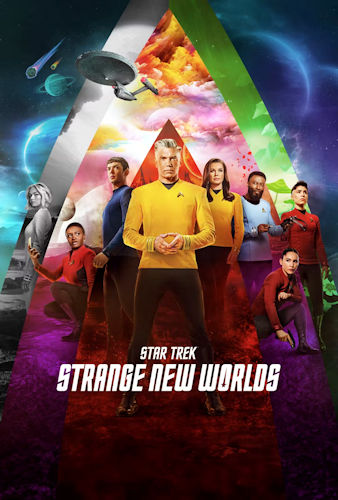
Watch Star Trek: Strange New Worlds on Prime Video
STAR TREK: STRANGE NEW WORLDS is based on the years Captain Christopher Pike manned the helm of the U.S.S. Enterprise. The series will follow Captain Pike, Officer Spock and Number One in the years before Captain Kirk boarded the U.S.S. Enterprise.
Watch Now!As an Amazon Associate I earn from qualifying purchases.