✨ Byte-Sized Overview
Humanity finally receives proof that intelligent life exists beyond Earth. Unfortunately, the reply arrives with all the warmth of an interstellar eviction notice.
War of the Worlds is a contemporary, multinational reimagining of H. G. Wells’s novel rather than a faithful adaptation. Set mainly in Britain and France, it follows scattered survivors after an extra-terrestrial attack kills most of the human population. Neuroscientist Bill Ward and astronomer Catherine Durand gradually emerge as its central figures, approaching the mystery from different countries and different branches of science.
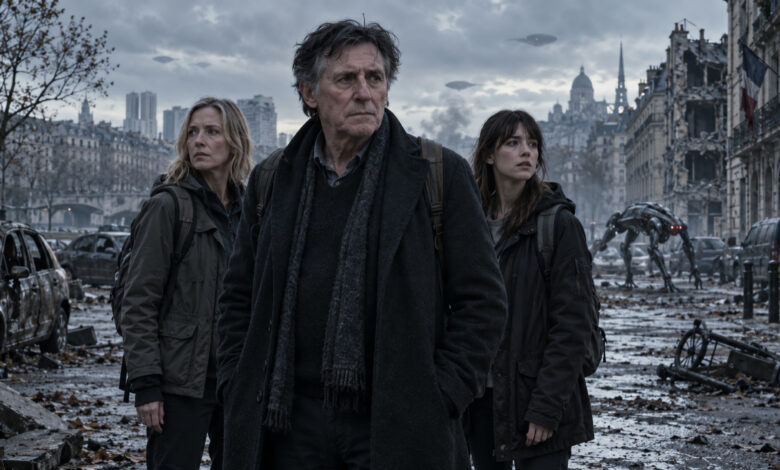
Anyone expecting Martian tripods marching across the landscape should recalibrate their targeting system. The invaders initially deploy agile quadrupedal killing machines, while the larger mystery concerns who created them, why humanity was attacked and what connects certain survivors to the enemy. The answers eventually carry the programme far beyond a conventional invasion story.
Its greatest strength is atmosphere. Empty cities, abandoned roads and ordinary buildings stripped of human activity create a convincingly desolate Europe. The deliberate pacing may test viewers wanting constant battles, but it gives the characters’ grief, fear and moral compromises room to matter. Three seasons were produced, with the third presented as the final chapter and the central story brought to a conclusion.
🎬 Transmission Details
- Show Title: War of the Worlds
- Years: 2019–2022
- Created By: Howard Overman
- Network: Canal+, Fox, Star and Epix
- Seasons: 3
- Episodes: 24
- Starring: Gabriel Byrne, Léa Drucker and Daisy Edgar-Jones
- Supporting Cast: Elizabeth McGovern, Natasha Little, Bayo Gbadamosi, Ty Tennant, Stéphane Caillard, Adel Bencherif, Aaron Heffernan and Pearl Chanda
- Genre: Science Fiction, Alien Invasion, Post-Apocalyptic Drama
- Status: Ended
🎯 Signal Strength
- IMDb: 6.5/10
- Rotten Tomatoes: 78% Season 1 critics’ score, 67% audience score
- Skully’s take: A relentlessly sombre invasion drama that eventually adds future humans, time travel and enough family trauma to make the murderous robot dogs appear comparatively uncomplicated.
Ratings checked 11 September 2026 and may change.
📼 Spoiler Mode: Story Sync for Pub Chat
Major spoilers follow for all three seasons of War of the Worlds.
Season 1: Astronomer Catherine Durand detects a signal originating from Ross 128, apparently confirming the existence of intelligent extra-terrestrial life. Soon afterwards, metallic vessels appear above the world’s major population centres and transmit an electromagnetic signal that kills nearly everyone exposed to it.
Those protected underground, underwater or inside shielded metal spaces survive by chance. In London, Sarah Gresham and her children, Tom and Emily, live because their car is inside an underground car park. Sarah’s estranged husband Jonathan survives in Paris when his taxi plunges into the Seine. Kariem, attempting to enter Britain illegally, is protected inside a metal storage container.
Neuroscientist Bill Ward survives inside his laboratory and sets out to find his former wife, Helen, and their son, Dan. Bill and Helen eventually discover that Dan has been killed by one of the quadrupedal machines now hunting survivors. When they disable and examine one of the creatures, Bill discovers that it is a cyborg containing biological material rather than a purely mechanical weapon.
Catherine joins soldiers led by Colonel Mokrani and discovers that the alien transmissions include music previously broadcast into space by her observatory. She realises that humanity’s own signal may have attracted the attackers. Her efforts to understand the shared frequency used by the machines eventually suggest a way of disrupting them.
Blind teenager Emily can hear alien pulses that other survivors cannot detect. Exposure to the signal temporarily restores her sight, and the machines occasionally refuse to attack her. In France, Chloe Dumont’s disturbed son Sacha develops a similar connection and experiences visions of Emily despite never having met her.
Jonathan joins Chloe and Sacha while travelling towards the Channel. He learns that Sacha was conceived when Chloe was raped by her brother Noah and becomes increasingly alarmed by the teenager’s cruelty. Sacha allows one of the machines to kill Noah and later follows Jonathan and Chloe towards Britain.
Bill, Helen and the Greshams join forces at a London university. Emily begins a relationship with Kariem but becomes increasingly sympathetic towards the invaders, believing their violence may be no different from humanity’s wars. During one of her encounters with a machine, Helen is killed.
The alien hunters remove babies and unborn children from their victims, suggesting that the invasion has a biological purpose. Emily follows her connection to a vessel on the Thames, where she finds the missing babies and comes face to face with a humanoid being. The figure shows her a vision of a woman standing on a devastated planet, while Sacha continues moving towards her.
Season 2: Several months later, organised resistance groups have formed in London and France. Bill studies the humanoid attackers and discovers that their organs are deteriorating. He begins developing a biological weapon that blocks insulin production and could kill them.
Emily returns from the alien ship with fragmented memories and visions of Adina, the leader of the humanoid invaders. Adina tells Emily that Bill is responsible for her people’s suffering and urges her to kill him. Bill’s tests reveal that Emily’s DNA is almost identical to that of the invaders.
An injured humanoid named Micah reaches Catherine’s observatory. Unlike Adina, he opposes the campaign against humanity and carries mathematical formulas describing how matter can move through space and time. His brother Jokim and other invaders attack the observatory, killing Mokrani and Micah before the plan can be completed.
Jonathan, Chloe and Sacha reach London. Jonathan reunites with Sarah and his children but ultimately chooses to remain with Chloe. Sacha finally meets Emily, confirming the connection established through their visions. His feelings become obsessive and violent, and he murders Ash while trying to isolate Emily from the other survivors.
Bill secretly tests his biological weapon on Emily. Although he believes the experiment is necessary to save humanity, it places her life in danger and turns several survivors against him. He eventually injects her with a virus designed to be inherited by the invaders.
The humanoids are revealed not to be aliens in the conventional sense. They are the future descendants of Emily and Sacha, born from twins the pair will conceive after the invasion. Those descendants inherit a genetic condition from Sacha, become unable to reproduce naturally and develop failing organs.
Raised to hate their human ancestors, the future race travels back through time to invade Earth, harvest organs and ensure its own survival. The attack itself brings Emily and Sacha together, creating a closed causal loop in which the invaders cause their own existence.
Micah had planned to break that loop by travelling back to prevent Emily and Sacha from having children. After his death, Isla becomes disillusioned with Adina and agrees to help Bill use Micah’s calculations. Catherine brings the formula to London, but she is killed by one of the mechanical hunters before the plan can be completed.
Bill and Isla board a living alien spacecraft and programme it to travel into the past. Adina, Jokim and several other humanoids pursue them onto the vessel and are carried back with them. Isla dies from a gunshot wound shortly after they arrive.
Bill awakens near a hospital in the period before the invasion and sees Emily, still blind and accompanied by Sarah and Tom. Realising why Micah selected this destination, he leads Emily onto the hospital roof. Bill explains that her death will prevent the invasion and then pushes her from the building.
Killing Emily breaks the loop before she can conceive Sacha’s children. The invasion is erased from history, restoring everyone killed during the previous two seasons, including Helen, Catherine, Sarah, Dan, Mokrani and Ash. Bill is arrested for Emily’s murder, while Adina and the surviving humanoids are stranded in a reality where their civilisation never existed.
Season 3: The final season moves between the original post-invasion timeline and the altered reality created by Bill. In the new timeline, the attack never occurred and most former survivors have no memory of knowing one another. However, people begin experiencing visions and emotional fragments from lives they lived in the original world.
MI5 agent Zoe experiences memories of the invasion and visits Bill in prison. He tells her the truth about Emily, the future humans and his journey through time. Convinced that another catastrophe is approaching, Zoe breaks him out so he can investigate.
Catherine, alive in the revised timeline, detects a black hole near Earth. It was created when the living spacecraft transported Bill into the past, and its gravitational effects connect the two realities. Some people in the altered timeline experience visions, while those exposed in the original world suffer neurological damage and eventually fall into comas.
Adina and the surviving future humans are dying from both their inherited condition and the virus Bill placed in Emily. Unable to return to their ships or restore their civilisation, Adina decides to destroy humanity rather than accept extinction.
She forces Hiram to construct a particle accelerator using alien mathematics and Catherine’s research. The machine will draw the black hole towards Earth and amplify its gravitational waves until they kill anyone not protected underground, recreating the method used in the original invasion.
The future humans also capture Tom because his genetic relationship to Emily makes his blood compatible with their bodies. In the original timeline, Sophia and the remaining survivors contaminate Tom’s blood with warfarin, hoping it will kill any humanoids who use it for treatment.
Bill and Catherine discover that closing the black hole requires matching transmissions from both realities. Their work is coordinated with astronauts Richard and Juliet aboard the International Space Station, who must send the corresponding signal from the altered world.
Martha, one of the future humans, becomes pregnant with Tom’s child. Their relationship offers another possible future for the two branches of humanity, based on coexistence rather than the inherited resentment encouraged by Adina.
After Hiram completes the particle accelerator, Adina kills him. Zoe later shoots Adina, but her plan is already in motion. Bill and Catherine transmit their signal from the original timeline as Richard and Juliet respond from orbit.
The matching frequencies dissipate the black hole and save both versions of Earth. The resulting energy destroys the space station, leaving Richard and Juliet to die together in space. Catherine crosses between realities and falls into a coma in the altered world, where her life support is eventually withdrawn.
Bill is killed by one of the quadrupedal machines in the original timeline. His counterpart remains alive but comatose in the revised world, where his estranged son Dan returns to his bedside. The surviving humanoids are dying, bringing their campaign against humanity to an end.
Martha and Tom await the birth of their child, while Zoe and Kariem prepare to begin a relationship. Ash reconciles with Hayley, and the survivors in the original timeline can begin rebuilding. The war ultimately ends by breaking the cycle of hatred that created it, leaving both realities alive but permanently marked by their connection.
🧠 Vibe Check
- 🌑 Unusually bleak, even by post-apocalyptic standards, with safety always feeling temporary.
- 🏙️ Empty European cities and deserted public spaces create an eerie, recognisable form of devastation.
- 🧬 The survival story gradually develops into a dense examination of genetics, inheritance and causality.
- 🐕 The quadrupedal mechanical hunters give the series a distinctive and genuinely threatening enemy.
- 🕰️ Later seasons embrace time travel and parallel realities far more enthusiastically than the opening episodes suggest.
- 💔 Grief, separation and damaged families drive the drama more consistently than military resistance.
- 🔬 Scientists solve more problems than soldiers, although their survival rate does not make research look like the safest career choice.
Perfect if you like: The Walking Dead for scattered survivors and moral attrition without the zombies; Dark for family connections tangled through time and causality; Invasion for a patient, international account of an extra-terrestrial attack.
Worth knowing before you start: This is a slow-burn drama containing long stretches of silence, grief and cautious movement through abandoned locations. The pacing can become repetitive, and the emotional bleakness rarely lifts. It also bears only a loose relationship to Wells’s novel, so viewers waiting for Martian tripods, red weed and Victorian artillery will be waiting for quite some time.
You do not need to watch any previous adaptation. This version establishes its own characters, invaders and mythology, borrowing Wells’s basic premise rather than continuing or closely reproducing another screen story.
🚀 Why It’s a Sci-Fi Icon
Calling War of the Worlds an icon may be slightly generous given its limited cultural footprint, but it deserves recognition as one of the most ambitious television reinventions of Wells’s famous invasion story.
- 🌍 It transforms a British classic into a European catastrophe. Parallel stories in Britain and France create an international scale without reducing the survivors to anonymous pieces on a global map.
- 👽 It refuses to repeat familiar invasion imagery. Living spacecraft, humanoid descendants and quadrupedal machines give the series an identity distinct from the tripods and Martians of earlier adaptations.
- 🧬 It embeds the invaders within humanity’s own future. The central conflict grows from human genetics, reproduction and inherited resentment, turning an attack from space into a closed loop of cause and consequence.
- 🧪 It makes scientific investigation essential to the story. Neuroscience, astronomy, genetics and theoretical physics repeatedly change what the survivors understand and what choices remain available.
- ⏳ It substantially evolves its premise across three seasons. The programme moves from survival horror into temporal paradox and intersecting realities instead of simply repeating attacks and escapes.
- 🤝 It ultimately argues for reconciliation rather than extermination. Beneath the violence is a story about grievances passed between generations and the possibility of choosing something other than revenge.
🔦 Deep Dive Highlights
- 🧠 Bill Ward: Gabriel Byrne gives Bill an exhausted intelligence and formidable stubbornness. His willingness to make morally appalling choices for what he considers the greater good makes him both the programme’s problem-solver and one of its most troubling figures.
- 🔭 Catherine Durand: Léa Drucker brings warmth and authority to a scientist whose discovery begins the story and whose understanding eventually becomes vital to resolving it. Her personal relationships prevent her from becoming merely the person assigned to explain the astrophysics.
- 👁️ Emily Gresham: Daisy Edgar-Jones plays Emily as vulnerable without making her passive. Her restored sight and connection to the invaders place her at the centre of the mystery, while her need for independence remains painfully human.
- 🧒 Sacha Dumont: Mathieu Torloting makes Sacha disturbing long before the full significance of his behaviour becomes clear. He embodies the programme’s interest in whether violence is inherited, learned or consciously chosen.
- 🦾 The mechanical hunters: Fast, efficient and stripped of personality, the machines are most effective when glimpsed moving through otherwise silent streets. Their compact design is both believable and sufficiently alien to remain unsettling.
- 🏚️ The abandoned world: Modern European locations are used exceptionally well. Hospitals, galleries, tunnels, universities and housing estates become temporary fortresses surrounded by unnerving emptiness.
- 🧬 The causal loop: What initially appears to be a conventional alien attack develops into a story where victim, aggressor, ancestor and descendant cannot be cleanly separated. It is ambitious science fiction, although keeping a small temporal whiteboard nearby would not be an unreasonable precaution.
- 🎵 “Into My Arms”: Nick Cave’s melancholy song recurs as an emotional motif, adding tenderness and loss to a series rarely inclined to offer its characters much comfort.
Skully's independent editorial rating A grim, atmospheric and increasingly ambitious reinvention that replaces familiar Martian machinery with fractured families, future descendants and one extremely complicated temporal grievance.Skully's Score
What works
What may not
Recommended Sci-Fi TV Products
Watch The X-Files on Prime Video
A young FBI agent is assigned watchdog duty over a fellow agent, but finds herself drawn into his investigations of paranormal and unexplained phenomena.
Watch Now!
Watch Fallout on Prime Video
Based on one of the greatest video games of all time, Fallout is the story of haves and have-nots in a world in which there’s almost nothing left to have.
Watch Now!
Watch The Expanse on Prime Video
Amidst political tension between Earth, Mars and the Belt, the single greatest conspiracy of all time must be unravelled.
Watch Now!As an Amazon Associate I earn from qualifying purchases.