✨ Byte-Sized Overview
Imagine discovering that your memories, talents, relationships and deepest convictions were installed for somebody else’s convenience. Worse still, imagine that the person responsible considers this excellent customer service.
That is the disturbing premise of Dollhouse, a science-fiction thriller about a secret organisation that hires out people whose identities can be erased and replaced. Its clients receive apparently perfect companions, specialists and operatives. The people supplying those services rarely understand what has been done to them.
At the centre is Echo, played by Eliza Dushku, who begins retaining fragments of experiences that should have disappeared. What initially resembles a series of undercover assignments gradually becomes a larger story about corporate power, manufactured identity and the struggle to reclaim control of your own mind.
Created by Joss Whedon, Dollhouse is ambitious, uneven and frequently uncomfortable. Its strongest material emerges when it stops treating its premise as a clever delivery system for adventures and confronts the human cost of making people programmable.
🎬 Transmission Details
- Show title: Dollhouse
- Years: 2009–2010
- Created by: Joss Whedon
- Network (US): Fox
- Network (UK): Sci Fi Channel
- Seasons: 2
- Episodes: 26
- Starring: Eliza Dushku, Olivia Williams, Harry Lennix, Fran Kranz, Tahmoh Penikett, Dichen Lachman and Enver Gjokaj, with recurring appearances from Amy Acker, Miracle Laurie and Alan Tudyk
The episode total includes Epitaph One, which was not shown during the original US network run but was released on home video and broadcast in the UK. There is also an alternative, unaired pilot called Echo, separate from the 26-episode main series.
For a first viewing, begin with Ghost, watch Epitaph One after Omega at the end of Season 1, then continue through Season 2 to Epitaph Two: Return. Save the alternative pilot for afterwards as a production curiosity.
Despite being cancelled, the series reaches a deliberate conclusion rather than simply stopping on an unresolved cliffhanger.
🎯 Signal Strength
- IMDb: 7.7/10
- Rotten Tomatoes: 72% critics / 84% audience — series averages
- Skully’s take: A luxury wellness retreat where the complimentary treatments include yoga, fresh fruit and having your entire personality deleted.
📼 Spoiler Mode: Story Sync for Pub Chat
Major spoilers ahead for both seasons and the series finale.
The Los Angeles Dollhouse operates beneath a carefully maintained surface of calm. Its residents, known as Actives or Dolls, spend their downtime in a suggestible, childlike state. Before an assignment, technician Topher Brink installs a personality containing the memories, abilities and emotional responses needed to fulfil a client’s request. Afterwards, those experiences are supposedly removed.
Adelle DeWitt manages the operation, presenting it as a controlled arrangement from which everyone benefits. Echo’s handler, Boyd Langton, appears to provide a more protective presence. Outside the organisation, FBI agent Paul Ballard becomes obsessed with finding the Dollhouse and rescuing Caroline Farrell, the woman Echo was before her original identity was taken away.
However, Echo does not remain the empty vessel her employers expect. Memories and instincts begin surviving the wipes. Her emerging awareness develops beyond simply recovering Caroline: the experiences of her different identities contribute to a new self, one capable of questioning the people giving her orders.
The rogue Active Alpha provides a dangerous contrast. After retaining numerous imprinted personalities simultaneously, he becomes violent and fixated on Echo. He forces a similar composite event upon her, expecting her to become his partner. Instead, she rejects him. Their shared capacity does not produce the same choices, suggesting that accumulated information alone cannot explain the person someone becomes.
Other revelations undermine the distinction between staff, clients and victims. The Dollhouse’s doctor, Claire Saunders, discovers that she is actually the Active Whiskey, carrying a manufactured medical identity. Ballard’s neighbour and romantic partner Mellie is another Active, November, positioned within his life without his knowledge. Even apparently private relationships have been shaped by the organisation.
Sierra’s history exposes the cruelty behind its claims of voluntary participation. Originally an artist named Priya, she was drugged and institutionalised after rejecting a wealthy man, Nolan Kinnard. Her supposed treatment delivered her into a system that allowed him to purchase her compliance. When Topher discovers what happened, he restores Priya’s identity rather than sending another obedient personality back to Nolan. She kills Nolan during their confrontation, and Topher helps conceal the aftermath. Technical detachment is no longer an adequate defence for what he has enabled.
The second season expands the threat beyond individual Dollhouses. Their parent organisation, Rossum, is developing technology capable of rewriting people without the elaborate preparation initially required. Personalities become transferable assets, bodies become replaceable hosts, and control of the system offers a route to almost unlimited power.
The sharpest betrayal is Boyd’s revelation as one of Rossum’s founders. His apparent protection of Echo has concealed an interest in her unusual resistance to imprinting. He wants to exploit that resistance to provide immunity for a chosen few. The team destroys Rossum’s mainframe, but dismantling one facility cannot remove knowledge that already exists.
Epitaph One shows the consequences in 2019: civilisation has collapsed after mind-wiping technology spreads beyond its original confines. The final episode returns to that devastated world in 2020, where Echo and her allies attempt to reverse the damage.
Topher develops a device intended to restore people’s original personalities, sacrificing himself to activate it. Paul is killed during the group’s return to the Dollhouse. Echo ultimately chooses to incorporate a stored imprint of him into her own mind, preserving a version of their connection rather than bringing him physically back to life.
The ending offers the possibility of recovery, not an instant return to normality. Lives have been lost, identities disrupted and relationships permanently changed. The people who survive must decide what freedom means after spending so long having their choices made for them.
🧠 Vibe Check
- 🧠 Memory manipulation, unstable identities and the question of what makes a person themselves
- 🏢 Corporate conspiracy hidden behind reassuring language and immaculate surroundings
- 🎭 A shifting ensemble whose characters can become radically different people between scenes
- ⚖️ Disturbing questions about consent, exploitation and responsibility, with flashes of dry humour
Perfect if you like: Westworld for manufactured identities and rebellion, Severance for corporate interference with the self, or Orphan Black for performances that explore different personalities within a science-fiction conspiracy.
This is darker and less immediately welcoming than its glamorous premise might suggest. Sexual exploitation, coercion, abuse and violence are central concerns, not incidental background details.
The early episodes can feel like variations on an assignment-of-the-week formula. Man on the Street, the sixth episode, is a useful point at which to judge whether the expanding mystery has caught your interest. Later episodes become much more serialised, although the accelerated final stretch sometimes moves faster than its revelations deserve.
🚀 Why It’s a Sci-Fi Icon
Dollhouse is more a provocative cult series than a universally celebrated landmark. Its place in science-fiction discussion rests on the questions it raises, the performances it makes possible and the risks it takes with its premise.
- 🧩 It makes identity an evolving question: Echo’s development complicates the familiar idea that restoring someone’s original memories automatically solves everything. If new experiences create a new person, does that person have an equal right to exist? The series becomes most interesting when recovery and erasure are no longer straightforward opposites.
- 💼 It gives exploitation a respectable office: The Dollhouse’s staff have procedures, professional language and carefully maintained boundaries. None of those things makes the underlying business harmless. Its polished environment is effective because the people operating it can describe their work as reasonable while avoiding the perspective of those whose minds they control.
- 🎭 Its premise gives the ensemble unusual opportunities: Dichen Lachman and Enver Gjokaj are particularly compelling when changes in voice, posture and expression establish an entirely different identity. These performances are not merely party tricks. They make the difference between a body, an installed personality and an emerging sense of self visible.
- 🔬 It connects invention with responsibility: Topher initially approaches personalities as fascinating technical constructions. The series gradually forces him to recognise the people affected by his work. His intelligence does not excuse his decisions, and his increasing distress cannot undo them, making him a more interesting figure than the uncomplicated resident genius.
- 🌍 It follows its technology beyond the original business model: A service sold to wealthy clients has implications far beyond private fantasy. If identity can be overwritten, the consequences reach politics, warfare, labour and the survival of individual autonomy. The later episodes push that logic to its destructive extreme rather than keeping the invention conveniently contained.
- ❓ Its contradictions remain worth discussing: The programme sometimes packages exploitation with the same glamour it wants viewers to question. That tension can weaken its criticism, especially early on. Yet its strongest episodes confront the problem directly, making Dollhouse a series to argue with as well as follow. Admiring its ambition does not require overlooking its missteps.
🔦 Deep Dive Highlights
- 👤 Echo: Eliza Dushku’s central character becomes more engaging as she moves from being whatever an assignment requires towards deciding what she wants for herself. Watch for small acts of recognition and resistance between the larger action sequences. Her development depends as much on those moments as on dramatic discoveries.
- 🥃 Adelle DeWitt: Olivia Williams gives the Dollhouse’s manager an imposing combination of precision, restraint and emotional concealment. Adelle can sound reassuring while making an appalling decision. Her most revealing scenes often concern the gap between the standards she claims to uphold and the compromises she is prepared to accept.
- 💻 Topher Brink: Fran Kranz turns an initially flippant technical prodigy into one of the series’ most emotionally complicated characters. Topher’s humour and enthusiasm can be appealing, but the work underneath them is deeply troubling. His scenes ask whether understanding how something functions is remotely equivalent to understanding what it does to people.
- ❤️ Sierra and Victor: Dichen Lachman and Enver Gjokaj provide an important emotional counterweight to the larger conspiracy. Their connection persists in ways the organisation struggles to explain or regulate. Their story is especially effective when it considers whether affection can survive without the memories that would normally give it context.
- 🕵️ Paul Ballard: Tahmoh Penikett’s investigator initially offers an outsider’s route into the mystery, but his determination is not free of complications. Wanting to rescue someone does not necessarily mean understanding them. His fixation invites questions about the difference between helping another person and imposing a role upon them.
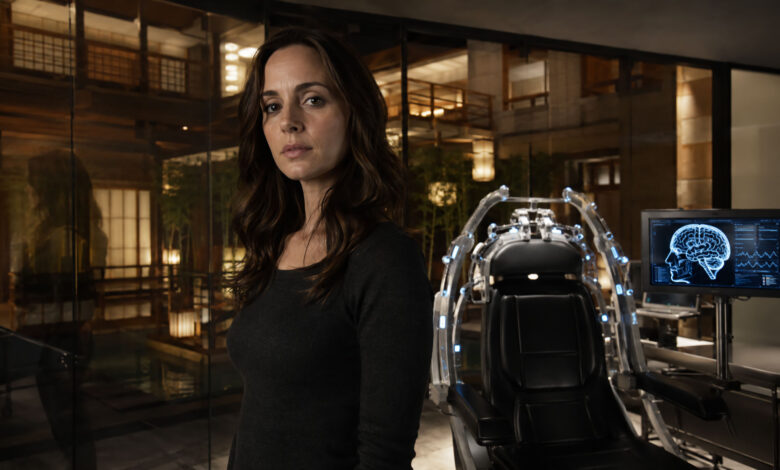
- 🪑 The Imprinting Chair: The show’s defining piece of technology makes the abstract threat immediate. Someone sits down, a procedure takes place, and the person who gets up may understand their entire life differently. Set against the Dollhouse’s soothing architecture, it becomes a disturbing symbol of control presented as care.
Dollhouse requires some patience and a willingness to engage with an uncomfortable premise. It does not always balance its thriller machinery with its ethical questions, and its compressed ending leaves some developments wanting more room. But when its characters begin challenging the system that defines them, it becomes absorbing, unsettling science fiction about a freedom so basic that losing it is difficult to imagine: the right to be yourself.
Recommended Sci-Fi TV Products
Watch Fallout on Prime Video
Based on one of the greatest video games of all time, Fallout is the story of haves and have-nots in a world in which there’s almost nothing left to have.
Watch Now!
Watch The Walking Dead on Prime Video
County Sheriff Rick Grimes, his wife, son and a small eclectic group try to survive constant attacks from zombies and other threats.
Watch Now!
Watch The X-Files on Prime Video
A young FBI agent is assigned watchdog duty over a fellow agent, but finds herself drawn into his investigations of paranormal and unexplained phenomena.
Watch Now!As an Amazon Associate I earn from qualifying purchases.